Tuy Hoa to Ganh Da Dia
Tuy Hoa · O Loan lagoon · Ganh Da Dia · Tuy Hoa
Illustrative regional or transport photo; not a promised stop. ©
Travel north for the coast's rock formations and a lagoon lunch. A full day gives enough time to walk the shoreline without turning the return into a night ride.
Why the rock is stacked in plates
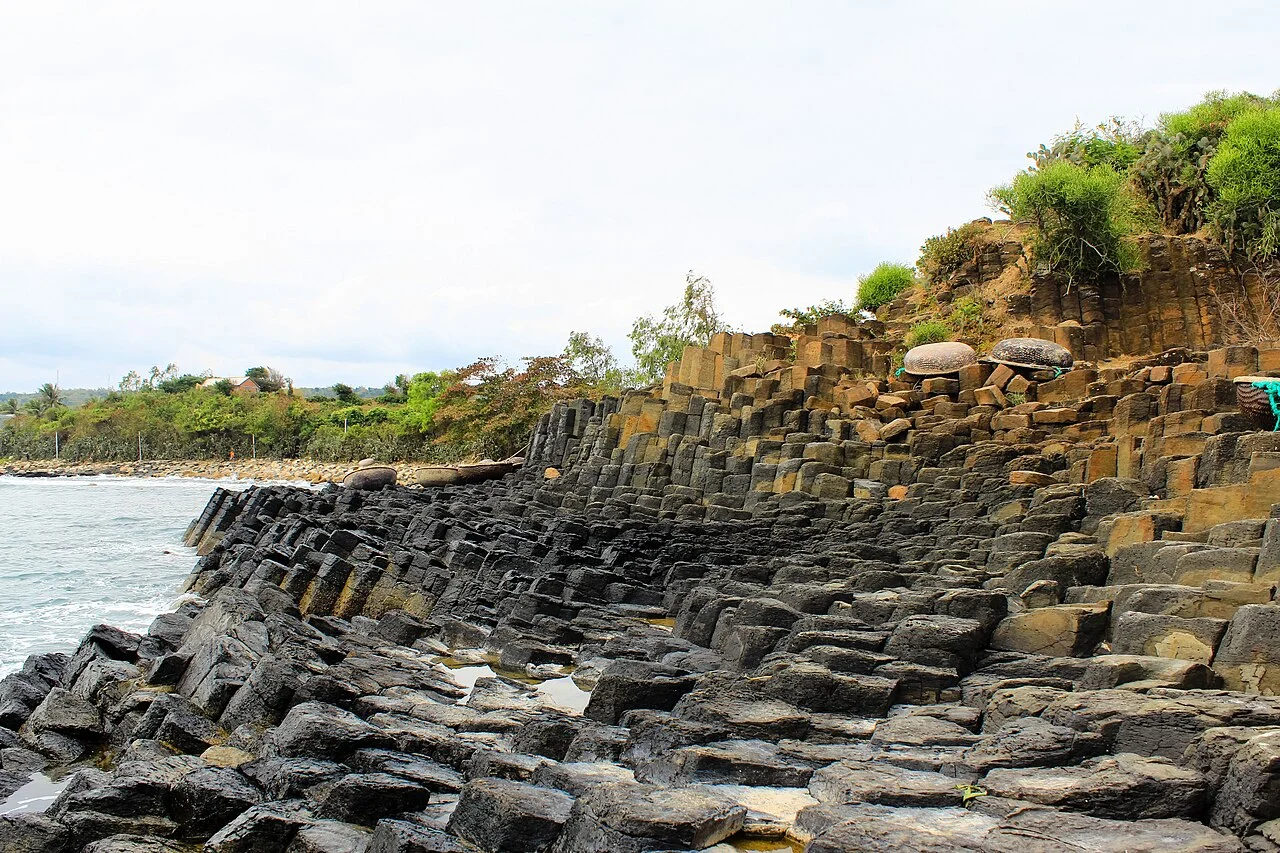
Gành Đá Đĩa is a short piece of coast where the rock comes out of the sea in columns. The geology behind it is old volcanism: lava erupted millions of years ago from what is now the Vân Hòa plateau, inland to the west, and as the flows cooled they contracted and cracked into prisms of roughly equal size. The columns that ended up at the waterline then took a second treatment — the swell worked into the joints and split them across, so each column reads as a stack of discs. That is the whole name: gành, a rocky shore; đá đĩa, plate stone. The main area is about 2,700 square metres and runs out in two small headlands. On the northern one the columns lean and curve; on the southern one they stand almost upright in steps from low to high, and that is the part people walk out on. There are only a handful of comparable places in the world — the Giant's Causeway in Northern Ireland, Los Órganos in Spain, Fingal's Cave in Scotland, the Jusangjeolli cliffs on Jeju — and a few more on this same stretch of Vietnamese coast.
Two stories and a whale shrine
The village has never needed the geology. One story says the stone was a treasury — gold, silver and jewels — and that thieves came one night and set fire to it to get at the hoard; a whirlwind took them away with a terrible noise, and in the morning the treasure had turned to stone. The other is gentler: the immortals came down to this beautiful place with golden cups and jade dishes for a banquet, enjoyed themselves too much, and left the stacked plates behind, which hardened into rock. At the south-western edge of the site stands the Lăng Đá Đĩa, a shrine to the Nam Hải god — the whale, Cá Ông, whom the fishermen of this coast honour — built around the middle of the nineteenth century under Tự Đức. The site was listed as a national scenic monument on 23 January 1997 and raised to a special national monument by the Prime Minister on 31 December 2020.
The church that keeps the first book
Ten kilometres inland from the columns, on the bank of the Kỳ Lộ river, stands a small blue-grey Gothic church with two bell towers and a cross between them. Mằng Lăng was begun in 1892 by Father Joseph de La Cassagne, the parish's first priest, and it is the oldest church in the old province. It is named after a tree: the area was forest a century and more ago, and one common tree with oval leaves and clustered pink-violet flowers was the mằng lăng. The forest is gone, but a round table 1.7 metres across, cut from that wood when the church was built, is still inside. In a vaulted chamber under an artificial hill in the forecourt, carved with scenes from the life of Anrê Phú Yên — the young martyr born in this parish — the church keeps a copy of the Phép giảng tám ngày: the catechism Alexandre de Rhodes had printed in Rome in 1651, 319 pages with Latin and Vietnamese in parallel columns, published alongside his Vietnamese–Portuguese–Latin dictionary, and the first prose book ever printed in the Vietnamese alphabet.
The lagoon on the way up
The road north leaves the Tuy Hòa plain and climbs the Quán Cau slope, and the lagoon of Ô Loan opens below it: seventeen and a half square kilometres of brackish water a metre or so deep, with one narrow channel to the sea, hills on three sides and a dune on the fourth. It has been a national scenic site since 1996 and it is known across the country for its blood cockles. Come down off the highway onto the shore lane and take lunch there rather than pushing on — the kitchens are family places above the water, the cockles are grilled in the shell over charcoal, and you will not be hurried. In the first lunar month the villages race boats on the lagoon, and in the flood months the water rises over the low roads at its head.
How the day works
It is about a hundred kilometres there and back, and the riding is easy: Highway 1 north for the first hour, then small roads through rice and coconut to the coast, and the same country roads home. What makes it a full day is that the three stops all want time on foot. The columns are a walk over uneven, wet, sloping stone with the sea coming into the gaps; the lighthouse at Gành Đèn is twenty minutes further along the shore path from the columns; and the church is a quiet half-hour rather than a photograph. Two practical things decide the rest. Go early — the site is exposed, the rock holds the heat, and the coaches arrive from mid-morning. And watch the sea: the lower plates are wet and slippery, and a swell reaches them without warning.
We lead this ride ourselves.
The guide is from our team, the route is one we have ridden, and you have one chat with us for the whole trip.
- Guides from our team
- Routes we have ridden ourselves
- Our workshop in five cities and partner workshops
- One chat with us for the whole trip
- 16
- cities
- 24
- tours
- 71
- routes
- 6
- workshops