Tra Vinh: Khmer temple roads
Tra Vinh · Ba Om Pond · Ang Pagoda · rural roads
Illustrative regional or transport photo; not a promised stop. ©
Give temple courtyards and the shaded pond time of their own. This gentle day is best ridden in short sections with shoes off, a walk and a meal between them.
A province that existed twice
Trà Vinh was a province from 1 January 1900 to 24 February 1976, stopped being one, was restored on 26 December 1991, and stopped again on 1 July 2025, when it was merged into Vĩnh Long. The city that was its capital is now the wards of Trà Vinh, Nguyệt Hóa, Long Đức and Hòa Thuận. It sits at the tail of the island between the Tiền and the Hậu, with 65 kilometres of coast on the East Sea, 200 kilometres from Ho Chi Minh City by Highway 53 through Vĩnh Long or 130 by Highway 60 through Bến Tre, and 50 from Cần Thơ. What makes the riding here unlike anywhere else in the delta is the giồng: old sand ridges running parallel to the shore in long curved lines, higher and broader the closer they are to the sea. They are the only ground that stays dry, so the villages, the roads and almost every pagoda stand on them, and a day's riding is a matter of moving from one ridge to the next across the wet ground between.
A hundred and forty-two pagodas
Kinh people make up a little over 67 per cent of the population here and Khmer 32 per cent, which makes this the second-largest Khmer population in the Mekong delta and in the country, after Sóc Trăng; Hoa and other peoples together come to under one per cent. There are 142 Khmer pagodas in the old province by one count and 144 by another — either way, more than the temples of the Kinh, the Hoa and everyone else put together. That number is the whole point of this route. A Khmer pagoda in the south is not only where monks live: it is where young men go to study, where the script is taught, where the five-tone ensemble and the rồ-băm court dance and the dù-kê opera are kept, and where the village keeps its books. It is also, almost always, a wood. Trà Vinh city alone has something over fifteen thousand trees, of which close to a thousand are more than a century old, planted in the French period, which is why people call it the city in the forest.
The square pond and the oldest pagoda
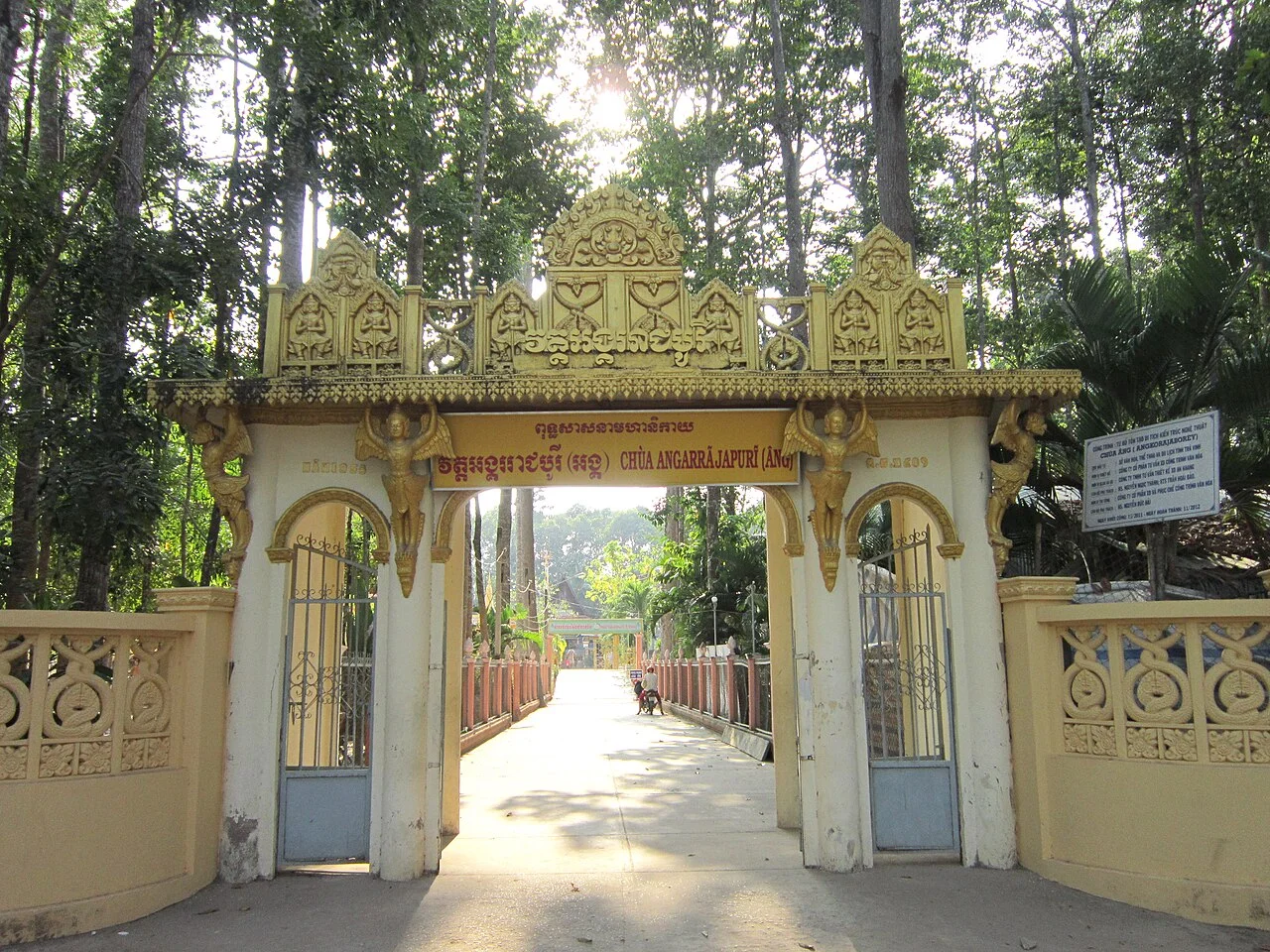
Seven kilometres out of town along Highway 53 there is a rectangle of water 300 metres by 500, close enough to square that people call it the Square Pond. Ao Bà Om is the pond, its banks and the belt of ancient sao and dầu trees around it whose roots stand clear of the sand in shapes it is hard to look away from. The story attached to it is a digging contest: to get fresh water for the dry season the village held a race between the men and the women, the losers to do the courting. The men worked and played. The women, led by one called Om, stalled them, and when their own pit was nearly finished they floated lanterns in the east so that the men took it for the morning star and knocked off early. The men's pond is still there and still dry. Beside the water stands chùa Âng — Angkorajaborey — the oldest Khmer pagoda in Trà Vinh, on four hectares inside a deep moat. The monument board dates it to 990; the hall was rebuilt in bamboo leaf in 1695 and again in 1842 in hardwood, sixty columns, tiled roof and masonry walls. Both were listed as national monuments on the same day, 20 July 1994.
Chùa Hang and what the bombs left behind
Six kilometres the other way, past the Tầm Phương salt sluice, is Kompông Chrây — the banyan landing, named for a ferry that used to run under a banyan by the gate. It was founded in 1637 and has had twenty-two abbots before the present one. Six hectares, half of it old sao and dầu. The main gate faces the river with two yeak guardians the size of men; the side gate on provincial road 36 is a barrel vault twelve metres long with walls thick enough that it looks like a cave, which is why everyone calls it the Cave Pagoda. During the Tết offensive of 1968 the place was wrecked by bombing. The monk Thạch Suông came back in 1977 and got it rebuilt, and is its twenty-third abbot. The grounds used to be full of bats; they left in 1968 and never came back, and egrets took over. The trees that were destroyed left whole root systems in the ground, and the abbot's idea was to bring in the carver Thạch Buôl to teach monks and local young men to work them. More than twenty have been trained, and the workshop is still running.
A coconut that is not quite a coconut
The strangest thing this province grows is dừa sáp — a coconut whose shell fills almost to the top with thick, soft, waxy flesh, leaving a small centre of clear liquid the consistency of jelly. The Philippines calls it makapuno; in Vietnam it is found only here, and mainly on the Cây Xanh ridge about four kilometres from Cầu Kè. The accounts agree on the outline: around the 1940s a Khmer monk of the Chợ pagoda brought back two seedlings from Cambodia, the trees did something here that they had not done there, and the fruit became a local monopoly. It stays one because it cannot be propagated the easy way — only the ordinary nuts on a waxy palm can germinate, a waxy one cannot be used for seed, and only two or three nuts to a bunch, about a fifth to a quarter, come out waxy at all. The rest of what the province is known for is easier to find: the noodle soup bún nước lèo, which is a Khmer dish before it is anyone else's and is served here salt rather than sweet and always with a dish of chilli salt; the Trà Cuôn sticky-rice cake; the Bến Có noodle soup; dried shrimp from Vinh Kim; and flattened green rice with coconut, which belongs to the moon.
We lead this ride ourselves.
The guide is from our team, the route is one we have ridden, and you have one chat with us for the whole trip.
- Guides from our team
- Routes we have ridden ourselves
- Our workshop in five cities and partner workshops
- One chat with us for the whole trip
- 16
- cities
- 24
- tours
- 71
- routes
- 6
- workshops