푸꾸옥: 섬에서 보내는 하루
Duong Dong · Long Beach · Ham Ninh · east coast
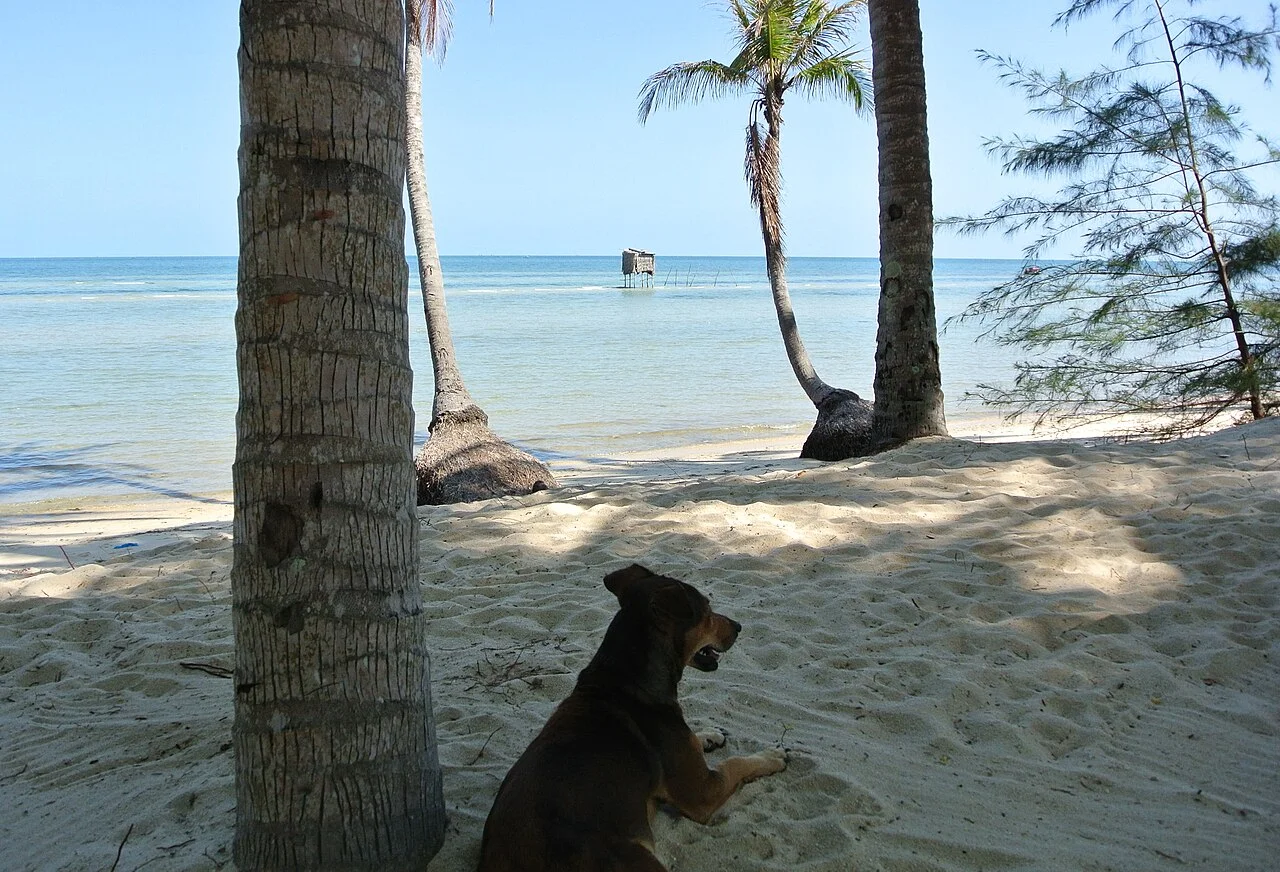
지역 또는 교통 참고 사진이며 약속된 방문지는 아닙니다. ©
Cross from the busier western shore to the fishing side of the island. Keep the schedule loose enough for a long lunch and return before the roads become unfamiliar in the dark.
The island everyone wrote letters about
Phú Quốc is the largest island in Vietnam: 575 square kilometres in the Gulf of Thailand, closer to Cambodia than to the Vietnamese mainland, with a permanent population of about 180,000. That position is why its paper trail is longer than its history of settlement. The British envoy John Crawfurd anchored off the north-west corner on 13 March 1822 and was told by the islanders that his party were the first Europeans they had seen; he noted the island as not less than thirty-four miles long and almost entirely forest. In 1855 Napoleon III confirmed Phú Quốc as Vietnamese, and in November 1856 the Cambodian king Ang Duong wrote to him listing the same island among the territories he considered Cambodian. France set up a Phú Quốc district on 25 May 1874 and opened the port of Dương Đông to foreign shipping the same day. The latest change of status is from our own decade: on 16 June 2025 Phú Quốc became a special zone of An Giang province, the only city in the country to be converted into one. Before that it was a city of Kiên Giang.
The camp at the southern end
The south of the island holds the heaviest thing on it. In 1949, after the Chinese Nationalists lost the mainland, General Huang Chieh brought more than thirty thousand soldiers from Hunan into Vietnam and the French quartered them at the southern end of Phú Quốc. When they left, the French used the buildings they had abandoned to open a camp of about forty hectares — Trại Cây Dừa, the Coconut Camp — holding close to fourteen thousand prisoners taken from the northern, central and southern fronts. During the next war the site became the central prisoner-of-war camp of South Vietnam: by 1972 it had twelve zones, each sub-camp built for 950 men, guarded by three military police battalions, and it held more than thirty-two thousand prisoners of war, forty thousand if political prisoners are counted. The site was listed as a national monument in 1995. What stands there now is a reconstruction of the camp with a martyrs' cemetery and a monument in the shape of a clenched fist. It takes an hour and it is not a beach stop.
Fish sauce, pepper and the anchovy that links them
Phú Quốc lives on two products, and they turn out to be one. The anchovies are mixed with salt fresh on the boat, which is what makes the difference: the salted fish, chượp, goes straight into wooden vats of bời lời wood — or vên vên or chai, since bời lời is now hard to find — one and a half to three metres across, two to four metres tall, seven to thirteen tonnes of fish each, and stays there for twelve months and sometimes fifteen. The first draw is nước mắm cốt at over thirty degrees of protein, the next over twenty, and by drawing, sunning and returning it some houses reach forty-two degrees naturally. Its colour, the brown of a cockroach wing, comes from salting the fish with the blood still in it, not from dye. Before 1945 there were nearly a hundred vat houses, mostly at Dương Đông and Cửa Cạn; war destroyed the Cửa Cạn ones and the trade moved to Dương Đông and An Thới. The appellation has been protected since 2001, with bottling on the island required since 2005. And the spent anchovy solids from the vats go out to the pepper gardens as fertiliser, along with cow and fish manure — two and a half to three thousand posts a hectare, two to three tonnes of pepper, picked by hand in stages from the eleventh lunar month to the end of the second.
Forest, reef and a dog with a ridge
The northern half of the island is still forest, and it is protected: Phú Quốc National Park was created by a decision of 8 June 2001 out of the earlier nature reserve, 31,422 hectares in all, of which 8,603 are under strict protection and 22,603 are ecological restoration; 12,794 hectares are forest and 929 plant species have been recorded. The sea has its own line of defence — a marine protected area of 187 square kilometres declared in 2007 at the two ends of the island, over coral, seagrass and mangrove — and the whole of it sits inside the Kiên Giang coastal and island biosphere reserve recognised by UNESCO in 2006. The island's other endemic is a dog. The Phú Quốc ridgeback is one of three breeds in the world with a ridge of reversed hair along the spine, the others being the Rhodesian and the Thai; it has webbing between its toes and swims, and Vietnam's kennel club registered it internationally on 14 December 2008.
One day, the southern half
The island is too big for one day and the north is the wrong half to try: its interest is the park, and the park is not a motorcycle route. This day takes the southern half, where the road is sealed all the way round and the distances are honest — just under seventy kilometres in total. Leave Dương Đông early for the stream at Suối Tranh while the shade still holds, cross to the east coast at Hàm Ninh for the calm water and an early lunch, run south down the coast road to An Thới for the prison site, and keep Bãi Sao and the cable-car pylons at the southern tip for the light of the late afternoon. Ride the west side home. Two constraints shape the whole thing: from May to October a squall can arrive in fifteen minutes and leave in twenty, and the last hundred metres to any of the good beaches is soft sand — park on the hard ground and walk it.
이 여정은 저희가 직접 이끕니다.
가이드는 저희 팀원이고, 경로는 저희가 직접 달려본 길이며, 여행 내내 저희와 하나의 채팅으로 연결됩니다.
- 저희 팀의 가이드
- 저희가 직접 달려본 경로
- 5개 도시의 저희 정비소와 파트너 정비소
- 여행 내내 저희와 하나의 채팅
- 16
- 개 도시
- 24
- 개 투어
- 71
- 개 노선
- 6
- 개 정비소