Phong Nha: hang động và đường quê
Phong Nha · Bong Lai · national park approach · Phong Nha
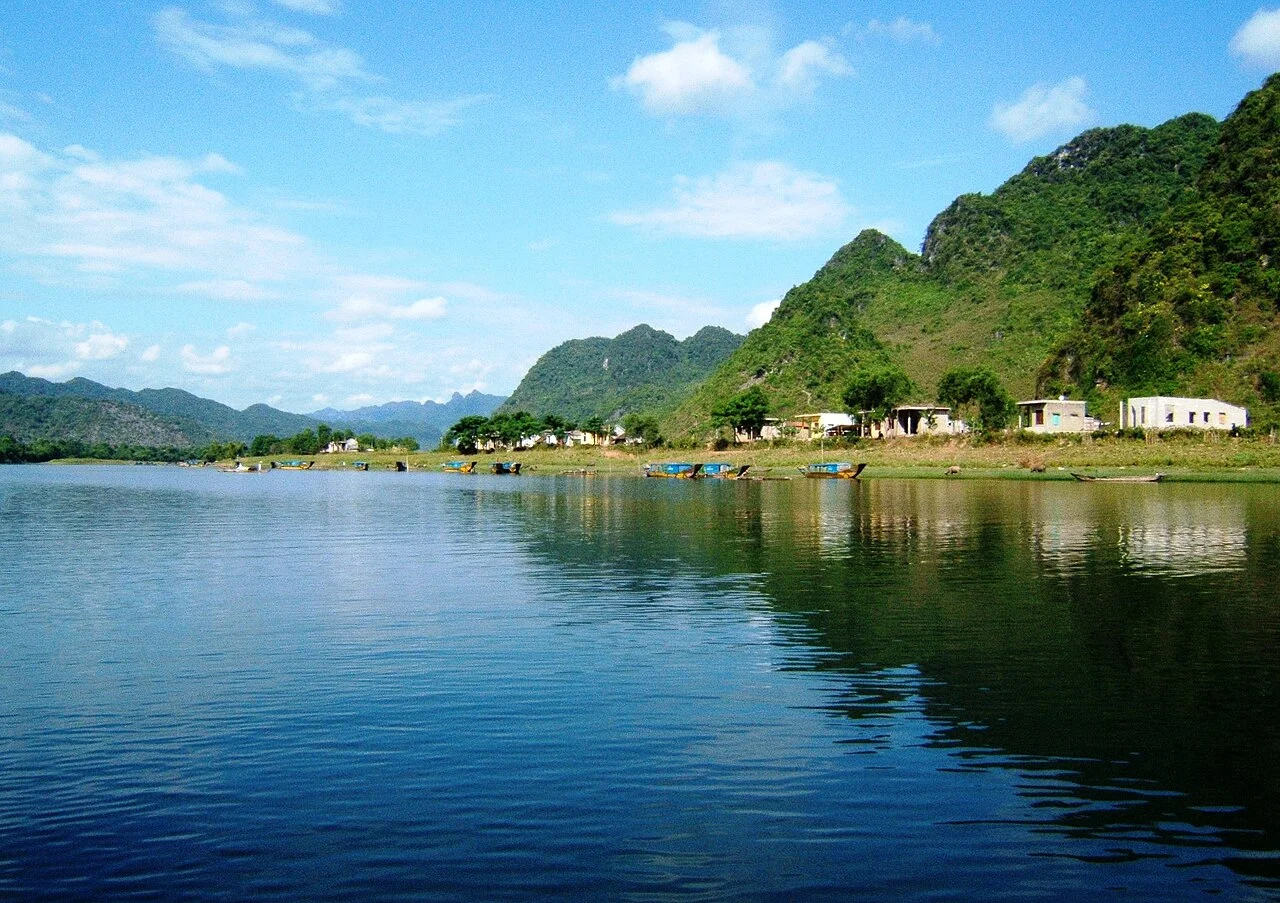
Ảnh minh họa vùng hoặc phương tiện, không phải điểm dừng cam kết. ©
Use two days: one for a selected cave, another for rural riding. Separating the activities avoids leaving a long underground visit with a demanding road stage still ahead.
Four hundred million years of limestone
Phong Nha–Kẻ Bàng is a national park and a UNESCO World Heritage Site, listed in 2003 for its geology alone — criterion viii, the record of the earth's history. UNESCO's own assessment is blunt about why: the karst here has been evolving since the Palaeozoic, some four hundred million years ago, which makes it the oldest major karst area in Asia. The limestone zone runs to about two thousand square kilometres on the Vietnamese side and meets another two thousand of Hin Namno across the border in Laos. Tectonic uplift and changing sea levels have left seven distinct levels of karst development stacked on top of each other, and the park protects around three hundred caves and grottoes along with the limestone forest of the Annamite range. Two dozen peaks here pass a thousand metres. You will not see most of this from the road; what you see is the wall of grey-green hills that the road keeps having to go around.
The river that comes out of the mountain
The cave that gave the park its name is entered from the water. The Son river runs about nineteen kilometres underground, draining a huge area of the limestone, and emerges at the mouth of Phong Nha cave; boats go up from the wharf in the village and then in through the entrance. The cave is 7,729 metres long and holds fourteen grottoes and an underground river measured at 13,969 metres, though visitors go about 1,500 metres in. People were here long before any of it was a park: Champa inscriptions on steles and Buddhist altars inside the cave date from the ninth century, before this coast was annexed in the southward expansion. In July 1924 an English expedition member named Barton rated Phong Nha the equal of Padirac in France and the Cuevas del Drach in Spain. The serious work started later — in 1990 a joint expedition of the British Cave Research Association and Hanoi University, led by Howard Limbert, began the survey that has not really stopped since.
Hồ Khanh's doorway
On 10 December 1990 a local man named Hồ Khanh, out looking for agarwood, found a cave entrance with a wind coming out of it strong enough to be remembered. He mentioned it in passing to members of the British Cave Research Association, could not find it again for years, managed to relocate it in 2008, and in 2009 led the expedition back. Between 10 and 14 April 2009 that expedition surveyed what turned out to be the largest known cave passage in the world by volume: Sơn Đoòng, more than five kilometres long, two hundred metres high, a hundred and fifty wide, with a fast subterranean river and two dolines where the ceiling has collapsed and a forest grows inside. The same season's work found twenty new caves and fifty-six kilometres of passage. You cannot ride to Sơn Đoòng or walk into it on a whim — access is by a single licensed multi-day expedition — but the road you are on passes the ridge it lies under.
Paradise, found in 2005
The other great cave of the park is one you can walk into. British cave researchers found it in 2005, explored it between 2005 and 2010, and announced a total length of 31.4 kilometres — the longest dry cave in Asia. They were sufficiently impressed by the formations to call it Thiên Đường, Paradise. Access was built afterwards: a road in from kilometre 16 of the western branch of the Hồ Chí Minh road, nearly five kilometres of it, then 1.6 kilometres of concrete path under the forest canopy, and finally either 524 stone steps or a 570-metre ramp up to the entrance. A 1.1-kilometre wooden walkway runs inside. It opened to visitors on 3 September 2010. Bring a jacket: the temperature inside sits far below the valley, and the walkway is wet.
Road 20, and why we give this two days
The road that runs west into the karst from Phong Nha is Đường 20 Quyết Thắng, 125 kilometres from here through Aky and Ta Lê to Phulanhich in Khammuane province in Laos, built as a branch of the supply route south and bombed accordingly; it is provincial road 562 now. On 14 November 1972 Company 217 of the youth volunteer corps was clearing the road for a convoy of 150 vehicles when American aircraft came back; eight volunteers, four men and four women, took shelter in a cave beside the road and a single boulder sealed the entrance. The memorial stands where it happened. That is the reason we split this into two days rather than one. A long cave visit takes three to five hours, most of it walking, and afterwards you do not want a demanding road stage — and this road deserves to be ridden slowly and stopped on, not covered.
Chúng tôi tự dẫn chuyến đi này.
Hướng dẫn viên thuộc đội của chúng tôi, tuyến đường chúng tôi đã tự chạy, và bạn có một kênh trò chuyện với chúng tôi suốt chuyến đi.
- Hướng dẫn viên từ đội của chúng tôi
- Những tuyến đường chúng tôi đã tự chạy
- Xưởng của chúng tôi tại 5 thành phố và các xưởng đối tác
- Một kênh trò chuyện với chúng tôi suốt chuyến đi
- 16
- thành phố
- 24
- tour
- 71
- hành trình
- 6
- xưởng