판티엣과 무이네: 항구에서 사구까지
Phan Thiet harbour · Po Shanu · Mui Ne fishing village · Red Dunes
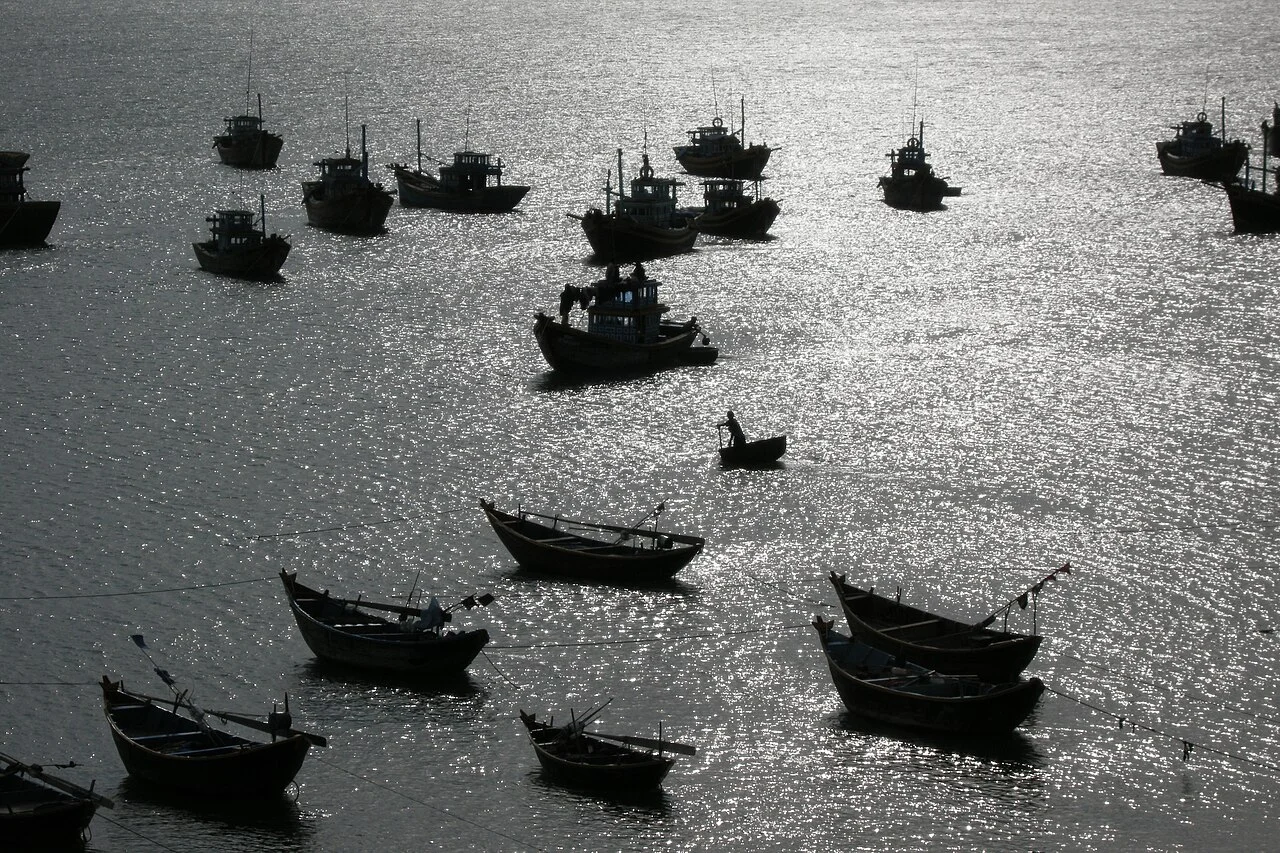
지역 또는 교통 참고 사진이며 약속된 방문지는 아닙니다. ©
Travel from the working harbour to the Cham towers and fishing coast. End with a walk on the dunes when the heat softens, keeping the motorcycle on the surfaced approach.
Hamu Lithit, the field near the sea
Before there were Vietnamese here this was Champa, and the Cham name for the place was Hamu Lithit: hamu, a settlement of flat rice fields; lithit, near the sea. Vietnamese speakers reshaped the Cham names of this coast into the ones on today's road signs — Panrang into Phan Rang, Panrik into Phan Rí, Hamu Lithit into Phan Thiết. Another account has the name from Po Thit, a Cham prince and the younger brother of the princess Po Sah Inư, who was posted to garrison this stretch in the fourteenth century. Either way the town sits where a river reaches the sea, which is what it has always lived on. Since the 2025 reorganisation Phan Thiết is a ward of Lâm Đồng province rather than the capital of Bình Thuận, and the Mũi Né ward next door covers 118.6 square kilometres with just over fifty thousand people. On the ground the difference is invisible: the same harbour, the same road out to the dunes.
The towers on Bà Nài hill
Seven kilometres north-east of the town centre, on the hill called Bà Nài, stand three brick towers built by the Cham at the end of the eighth and the beginning of the ninth century to worship Shiva. They are in the Hòa Lai style, one of the old architectural manners of Champa, and the group is about twelve hundred years old. Several sources say a much larger fourth tower stood here and has lain buried under rock and soil for more than three hundred years. In the fifteenth century further, simpler shrines were added, dedicated to the princess Po Sah Inư, whose name the group now carries. They are small — you will have walked round all three in twenty minutes — but they are the oldest standing thing on this route by a margin of a thousand years, and they look down on the harbour you started from.
Fish sauce as politics
The other thing this coast has always made is fish sauce, and in Phan Thiết that industry has a political history. In 1905 a group of patriotic scholars in Bình Thuận, responding to the Duy Tân reform movement of Phan Châu Trinh, Trần Quý Cáp and Huỳnh Thúc Kháng, founded a reading society; on 6 June 1906 they added a trading house, the Liên Thành Thương Quán, to earn the money and employ local people. They deliberately chose fish sauce, because it was a small trade that French and overseas Chinese capital had not yet taken over. In 1907 the same circle opened a school, Dục Thanh, to teach the children of poor and patriotic families. Part of the company's profits quietly funded Phan Bội Châu's Đông Du movement. And in 1910 a young teacher named Nguyễn Tất Thành — later Hồ Chí Minh — taught at that school for a while before going on to Saigon and out of the country.
The tower the prince designed
On the left bank of the Cà Ty river, in the middle of town, stands a water tower begun at the end of 1928 and finished at the start of 1934. The French administration built it under its urban plan, to supply the residency and then the town, and the design came from an unexpected hand: prince Souphanouvong of Laos, then working as an engineer, whose drawings were approved by the public works office in Hanoi before the job went out to tender. He would later become the first president of Laos. The tower is still the thing you steer by in the middle of Phan Thiết, and the fishing harbour is a few hundred metres downstream of it — boats moored three deep along both banks, ice going aboard in the afternoon, the fleet leaving at dusk.
Why the dunes come last
Mũi Né lies about 22 to 25 kilometres east of Phan Thiết and is reached by two roads: Nguyễn Đình Chiểu, the provincial road 706, and Võ Nguyên Giáp, the 706B, along the coast. The name has two common explanations: that mũi is the headland pushing out to sea and né means to dodge — the place boats ran to out of a storm; or that it comes from Nà Né, the nickname of a Cham king's youngest daughter, who died at sixteen and for whom a shrine was built near Hòn Rơm. What was a wild shore of red desert dunes with a few poor fishing hamlets now carries hundreds of resorts. Ride it in this order — harbour, towers, stream, village, dunes — and you get the working town before the tourist strip, and you arrive at the sand in the last two hours of light, when the heat has gone off it and the colour comes up. Do not take a road bike onto the sand itself: park on the surfaced approach and walk.
이 여정은 저희가 직접 이끕니다.
가이드는 저희 팀원이고, 경로는 저희가 직접 달려본 길이며, 여행 내내 저희와 하나의 채팅으로 연결됩니다.
- 저희 팀의 가이드
- 저희가 직접 달려본 경로
- 5개 도시의 저희 정비소와 파트너 정비소
- 여행 내내 저희와 하나의 채팅
- 16
- 개 도시
- 24
- 개 투어
- 71
- 개 노선
- 6
- 개 정비소