宁顺:海岸与占族文化遗产
Phan Rang · Po Klong Garai · Ninh Chu · Phan Rang
地区或交通示意照片,不代表承诺的停留点。 ©
Build a day that moves between the inland towers and the coast. The contrast works best with time for a proper temple visit and an unhurried beach lunch.
The towers on Betel hill
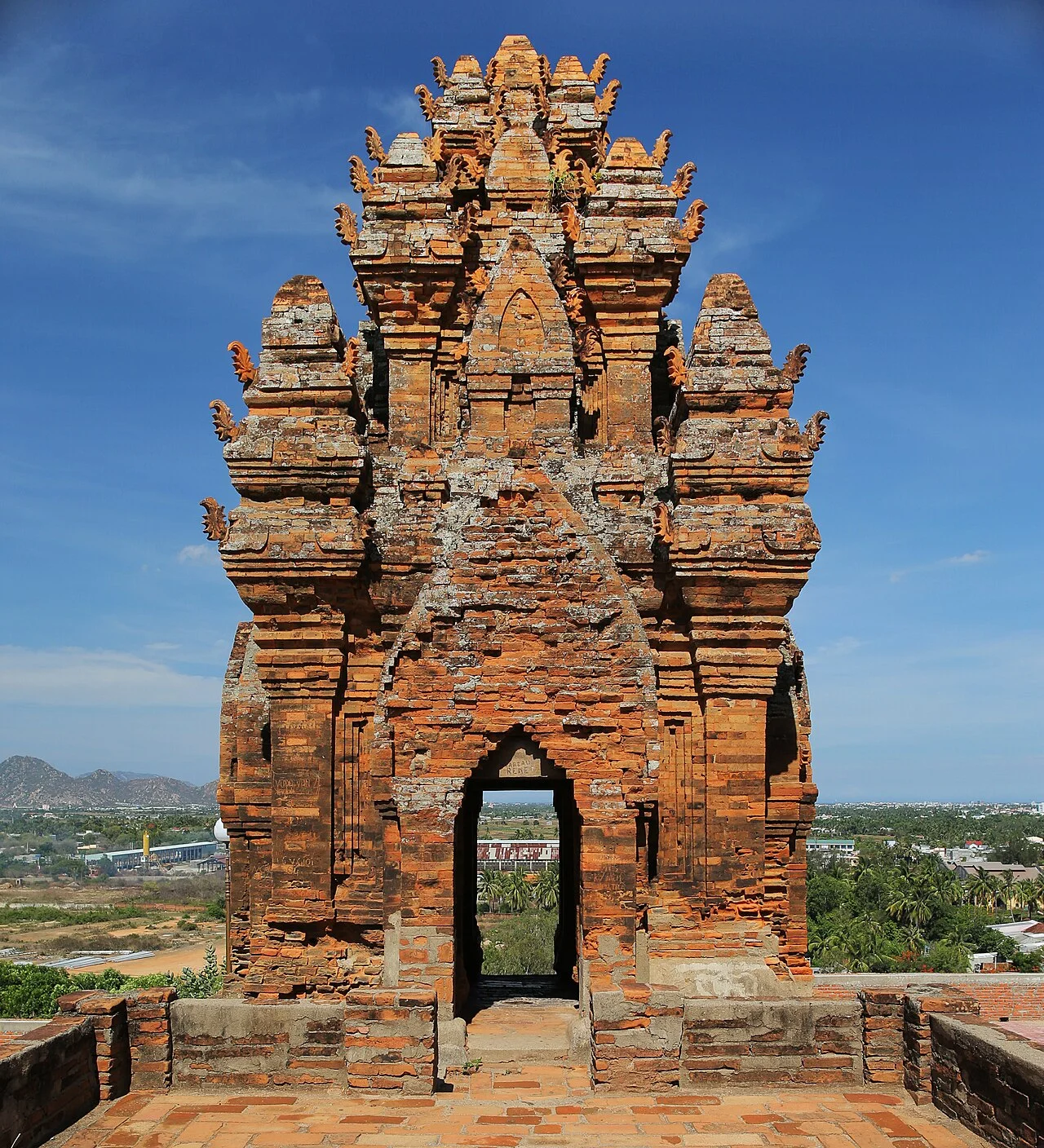
Three brick towers stand on đồi Trầu, Betel hill, on the western edge of Phan Rang: a main tower of 20.5 metres, a fire tower of 9.31 and a gate tower of 8.56. They were built at the end of the thirteenth century and the beginning of the fourteenth, under the king the Vietnamese called Chế Mân, to honour an earlier king, Po Klong Garai, who had ruled Panduranga from 1151 to 1205. Vietnamese scholarship treats them as the finest surviving Chăm tower group in the country. They were listed as a national monument in 1979 and later raised to special national monument, and on 18 January 2024 two objects inside the complex — the Phước Thiện stele and the statue of king Po Klong Garai — were added to the list of national treasures. This is not a ruin. The statue is worshipped, the tower is opened for festivals, and you are a guest.
The boy the dragons licked
The king these towers are for has a story rather than a biography. A childless couple at Play Chakling found a baby floating on the sea foam and raised her as Karit. In the forest one hot day she drank from rainwater standing on a rock, and the water filled again as fast as she drank, but had gone when she fetched her father. The child she bore was called Jatol, and he was ugly and covered in sores. Trading betel one day he stopped to rest on a rock, and his friend Po Klonchanh came back to find two white dragons licking him clean; the dragons vanished and the boy stood up handsome. In 1167 the court of Bal Sri Banây, left without an heir, sent a white elephant to fetch him, and he reigned as Po Klong Garai. When a Khmer commander blocked his return to Panduranga, he proposed a tower-building contest instead of a battle, built faster, and won the province without a fight.
Two villages that never stopped
Ten kilometres south of Phan Rang are two Chăm villages that Vietnamese writing calls the oldest craft villages in South-East Asia. At Bàu Trúc — Paley Hamu Trok in Chăm — pots are still built without a wheel: the potter walks backwards around the clay instead of turning it. The clay comes from the Quao river, dug half a metre down in pits that are then filled in and planted with rice and re-opened six months later. There is no glaze; the yellow-red, pink and smoke-grey of the finished pot is what the firing does. The founder is remembered as Po K'long Chan, the same close companion who appears in the king's story. A kilometre away at Mỹ Nghiệp, the weaving village the Chăm call Irahani, cloth is made on wooden frames with no machinery at all, in a tradition the weavers date to the tenth century, using dyes from the chùm bầu and mo plants and from river mud.
What the calendar does here
The Chăm year runs on its own clock. New year falls on 19 April. The big festival, Katé, falls on the first day of the seventh Chăm month, which lands somewhere between 25 September and 25 October, and it begins at the towers: the costume is received, the tower is opened, the statue is bathed and dressed, the great rite is performed, and when the sacred dance ends inside, the festival starts outside with the Gi Năng and Paranưng drums and the Saranai reed. It closes on the evening of the second day at the towers, moves to the villages the next day, and then into the houses, where the oldest man of the family leads it. In the ninth lunar month comes Chabur, for the goddesses, chief among them Pô Inư Nagar. All of this sits on much older ground: at Nhơn Hải, archaeologists have dug Sa Huỳnh burials with stone and iron goods about 2,500 years old.
How the day works
Eighty-five kilometres, flat, and the only thing that can spoil it is the sun. Chăm towers face east, so go to Po Klong Garai first, in the morning, when the light comes in at the door; then the two villages, which are indoor work and therefore the right thing to do at midday; then Po Rome, a three-tiered tower about eight metres high on its own hill, which still has the king's statue inside and is still used; then the sea. Ninh Chữ and the Đầm Nại lagoon are six kilometres from the middle of town, and the fifteen kilometres north to the Hòa Lai towers are worth it for what they show: three towers of the eighth or ninth century, the finest early Chăm architecture there is, and a central tower whose upper half was pulled down in the late nineteenth century so that the bricks could pave the mandarin road that is now Highway 1.
这段旅程由我们亲自带队。
向导来自我们的团队,路线我们亲自骑过,整个行程您只需与我们一个对话。
- 来自我们团队的向导
- 我们亲自骑过的路线
- 我们在 5 座城市设有维修点,另有合作维修站
- 整个行程只需与我们一个对话
- 16
- 座城市
- 24
- 条旅行线路
- 71
- 条路线
- 6
- 家维修点