昆嵩:河流与村庄
Wooden Church · Dak Bla river · Kon Klor bridge · Kon Klor village
地区或交通示意照片,不代表承诺的停留点。 ©
Follow a short arc through the town's wooden architecture and river landscape. The village visit works best with time to listen and ask, not simply to photograph buildings.
A town made of villages
Kon Tum is small — the ward covers 19.14 square kilometres and holds 77,456 people, which is dense for the highlands and tiny for Vietnam — and the thing worth understanding before you start the engine is that the villages are not outside it. They are it. The name is Bahnar: kon is village, tum is a lake or pond, and the story is that a settlement on the Đăk Bla called Kon Trang-Or fell into quarrelling over property and slaves until two sons of one of its headmen, Jơ Rông and Uông, took their people off to build by a pond beside the river. The Bahnar are still here in numbers: 286,910 across Vietnam at the 2019 census, of whom 68,799 lived in the old province of Kon Tum, an eighth of everyone in it. They are not one group. Take the town as the line: west of it the villages are Bahnar Rơngao, whose speech sits between Bahnar and Sedang; east of it, towards Kon Rẫy, they are Bahnar Jơlơng.
What a rông house is for
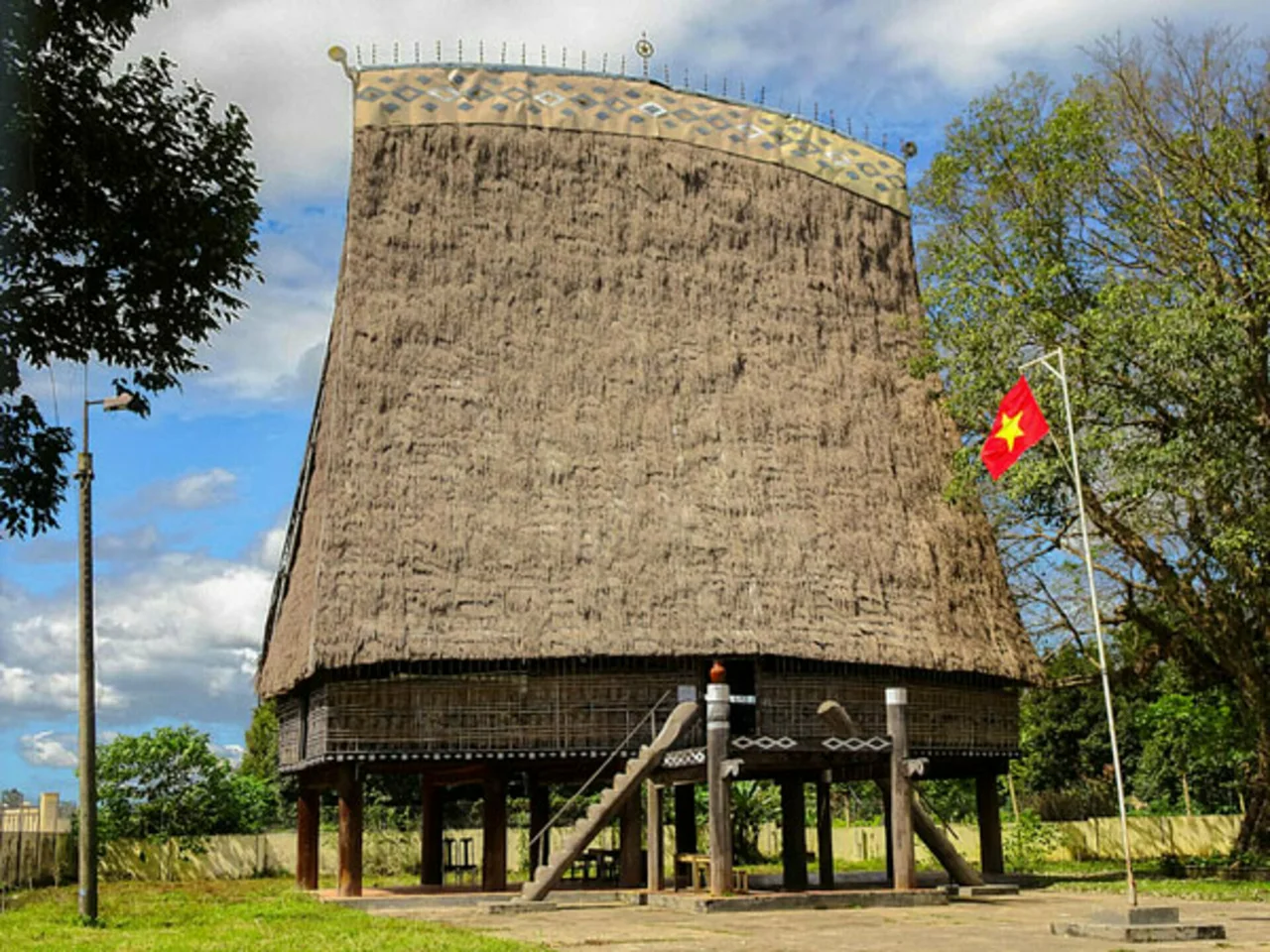
Every village has one and you cannot miss it: a stilt house far larger than any other, with a roof like an axe blade driven up into the sky, sometimes eighteen metres to the ridge. It is built of what the forest gives — thatch grass, bamboo, lồ ô, timber — on eight great columns of mature trees, and it stands in the middle of the village on open ground. The rông is not decoration and it is not a monument. It does the work a đình does in a Vietnamese village: the elders meet there to settle matters under customary law, the village assembles there, guests are received there whether they are the village's guests or one family's, and the unmarried and widowed men sleep there. It is where the community's rituals happen and where the old craftsmen hand the songs and patterns down. It is also the strongroom: the gongs, the drums, the weapons and the heads of the animals sacrificed at the festivals are kept inside it. Rông houses exist only in the northern Central Highlands, among the Jrai and Bahnar, and above all in the two provinces this road runs between.
The river and the orange bridge
The Đăk Bla — Krông B'Lah in the local form — runs 157 kilometres with a catchment of 3,436 square kilometres, and it is the main tributary that makes the Sê San. The town sits on its north bank; almost everything Bahnar sits on the south. Between them hangs the Kon Klor bridge, orange, 292 metres long and four and a half metres wide, begun on 3 February 1993 and opened on 1 May 1994, joining Kon Tum ward to the commune of Đăk Rơ Wa. Ride across it slowly. The far bank is a string of villages — Kon Klor, Kon Jơ Dri, Kon K'Tu — that the province lists as community tourism villages, which means visitors are expected and also that people live there and will be at work. The lane along the water gets rougher as it goes east, and Kon K'Tu at the end of it, four kilometres downstream with its own rông house and its own church, is as far as this ride needs to go.
What the town keeps on its own side
Three buildings, and they do not agree with each other. The wooden cathedral on Nguyễn Huệ was built between 1913 and 1918 out of cà chít hardwood by carpenters brought from Bình Định and Quảng Ngãi, Romanesque in plan and raised like a Bahnar stilt house, its walls made of earth mixed with straw with coloured glass set into them. Chùa Bác Ái went up in 1932 and the emperor Bảo Đại granted it the plaque Sắc tứ Bác Ái Tự the following year; its great bell, the one they call the U Minh bell, is currently being put forward for recognition as a national treasure. And down by the river stands what is left of the Kon Tum prison, built between 1915 and 1917, small and notorious, worst in 1930 and 1931. On 25 September 1930 a prisoner named Ngô Đức Đệ called a secret meeting in his own solitary cell and founded the first Communist Party branch in Kon Tum. The site now holds an exhibition house, a group of statues and the mass grave of the men who died there.
How the day works
Twenty-five kilometres, all of it inside or beside a town, and the whole point is that you will be off the bike more than on it. Do the town side in the morning — the prison memorial first, while it is cool and empty, then the cathedral — cross the bridge in the middle of the day and give the afternoon to the far bank. Go slowly there and do not treat the villages as a set of photographs: ask before you walk up into a rông house, ask before you point a camera at anyone, and take a refusal without discussion. Buy something if a stall is open. The lane beyond Kon Jơ Dri is loose and steep in places; if you are on a heavy bike, leave it and walk the last part. And keep an eye on the river in the wet months, because it rises fast and the low sections of the bank lane go under.
这段旅程由我们亲自带队。
向导来自我们的团队,路线我们亲自骑过,整个行程您只需与我们一个对话。
- 来自我们团队的向导
- 我们亲自骑过的路线
- 我们在 5 座城市设有维修点,另有合作维修站
- 整个行程只需与我们一个对话
- 16
- 座城市
- 24
- 条旅行线路
- 71
- 条路线
- 6
- 家维修点