Hoi An to My Son: a heritage day
Hoi An · Duy Xuyen · My Son · Hoi An
Illustrative regional or transport photo; not a promised stop. ©
Leave the lantern streets behind for an inland day with one substantial archaeological stop. The early arrival is useful for both walking comfort and a calmer return through villages.
A valley two kilometres wide
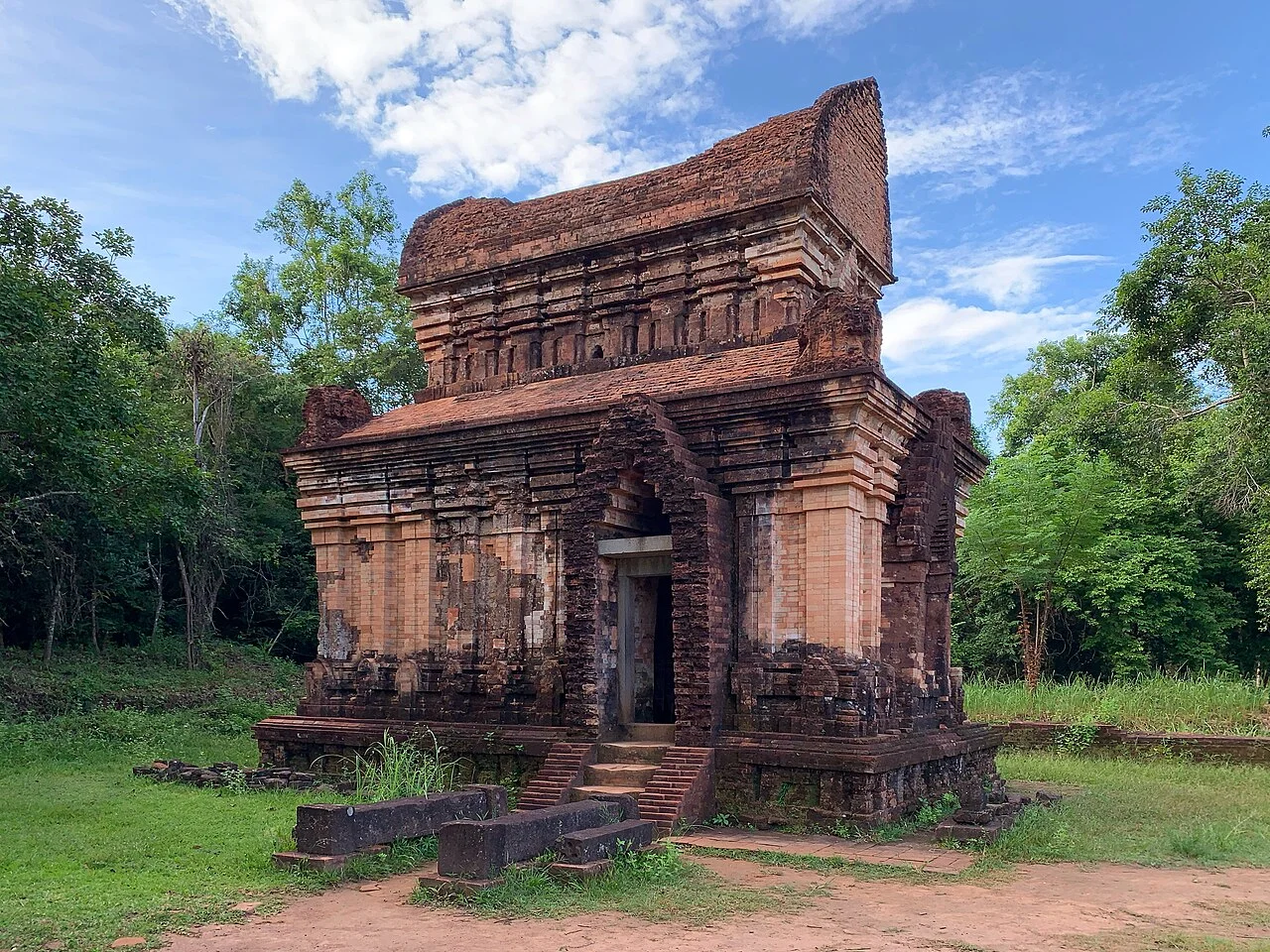
Mỹ Sơn is a cluster of Shaiva Hindu temples in a valley about two kilometres across, ringed by hills, some thirty-six kilometres south of Hội An and roughly ten from Trà Kiệu. From the fourth to the thirteenth century the kings of Champa held ceremonies here and buried their royalty and their heroes; the government itself sat elsewhere, in Simhapura at Trà Kiệu or Indrapura at Đồng Dương. It is probably the longest continuously used religious site in mainland Southeast Asia. The earliest events recorded on the stones belong to King Bhadravarman I, who ruled from about 380 to 413 and built a sanctuary here for the linga and for Shiva — venerated at Mỹ Sơn under the name Bhadreshvara, which fuses the king's own name with the god's. Inscriptions say the first temple was made of wood. It burned. What followed was brick, for nine hundred years.
Brick that nobody has explained
Almost every building at Mỹ Sơn is red brick; only one, the temple scholars label B1, is stone. The carving is cut directly into the brick rather than into sandstone panels set into the walls, which is what makes the surfaces feel continuous, as though the whole tower had been modelled rather than assembled. How the Cham bonded the bricks is still not fully understood — the joints are almost invisible and the mortar, if there was one, has never been satisfactorily identified. The standard building is a kalan, a brick sanctuary in the form of a tower housing a deity, and around it stand gate towers, halls and a kosagrha, the saddle-roofed treasure house. When Henri Parmentier began his study in 1899 he found the remains of seventy-one temples; his description appeared in 1904 in the Bulletin de l'École française d'Extrême-Orient. The site had been rediscovered the year before he arrived, in 1898, by a Frenchman named Camille Michel Paris.
One week in 1969
Most of what Parmentier catalogued is gone. The great majority of Mỹ Sơn's architecture was destroyed by American bombing during a single week of the war. The building known as A1 — the finest tower on the site and the one that gave its name to a whole style of Cham art, sometimes also called the Trà Kiệu style — is now, in the flat phrase of the record, little more than a formless pile of bricks. The craters are still there between the groups, filled with water and grass, and nobody has tidied them away; they are part of what you are looking at. Conservation has been continuous since: a UNESCO plan funded by Italy and Japanese sponsors, and between 2017 and 2022 the Archaeological Survey of India restored the A, H and K groups at a cost of 2.25 million US dollars, finishing on 20 December 2022. Worries about the stability of what is left have not gone away.
The Lion City on the way
Ten kilometres short of the sanctuary the road passes Trà Kiệu, which before 1975 people also called Bửu Châu hill. This was Simhapura, the Lion City, capital of Lâm Ấp from about 605 to 757 and the seat of Amaravati, the strongest of the five small kingdoms that made up Champa. In 605 the Chinese general Liu Fang marched south, beat Sambhuvarman's elephant riders and sacked the capital, carrying off more than a thousand Buddhist books and the gold tablets that recorded the reigns of the Cham kings. There is not much above ground now — a rampart line, a scatter of foundations, sculpture that went to museums — and a Catholic church on the hill that has become the landmark instead. It is worth the ten-minute stop precisely because it looks like nothing: this is what a capital looks like after fourteen hundred years.
Why you leave at seven
The ride is eighty-odd kilometres there and back, and almost none of it is difficult: the river plain of the Thu Bồn, nipa palm and rice, then a climb into the hills for the last stretch. The reason to start early is the site itself. Mỹ Sơn faces east, the light on the brick is best in the first two hours, the valley is a sun trap by ten, and the walking between the groups is longer than it looks on the plan. Go at seven, be at the gate when it opens, take three hours inside, eat in Điện Phương on the way back — this is the home of Cầu Mống roast veal and of Phú Chiêm mì Quảng — and be back in Hội An before the afternoon heat. In 1999, at its twenty-third session, UNESCO put Mỹ Sơn on the World Heritage list under criteria II and III: an example of cultural exchange, and the evidence of an Asian civilisation that no longer exists.
We lead this ride ourselves.
The guide is from our team, the route is one we have ridden, and you have one chat with us for the whole trip.
- Guides from our team
- Routes we have ridden ourselves
- Our workshop in five cities and partner workshops
- One chat with us for the whole trip
- 16
- cities
- 24
- tours
- 71
- routes
- 6
- workshops