Hanoi: lakes and living streets
Hoan Kiem · Truc Bach · West Lake · Temple of Literature
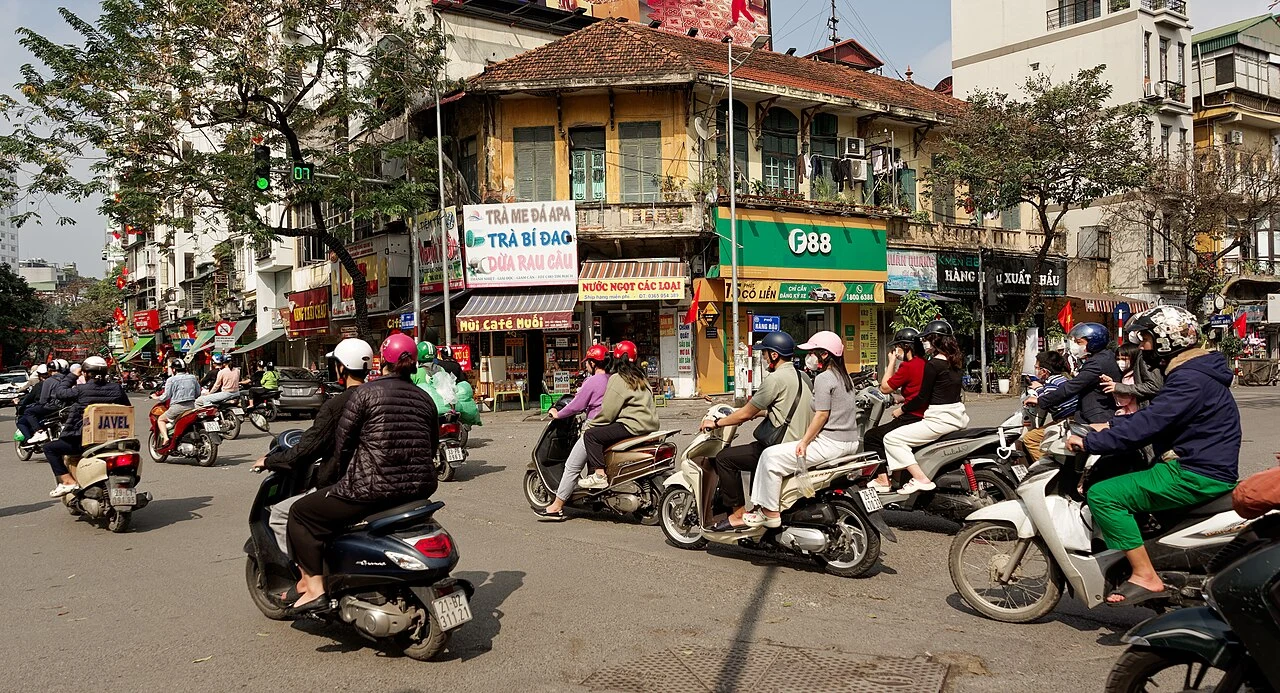
Illustrative regional or transport photo; not a promised stop. ©
Start with the lake before the streets fill up, then trade the tight centre for the wider waterfront. Leave time for a courtyard visit and a coffee overlooking the water.
A thousand years in the bend of a river
Hanoi began in 1010, when Lý Thái Tổ moved his court from the cramped fortress at Hoa Lư to a citadel on the west bank of the Red River and called it Thăng Long, ‘rising dragon’. It has been the capital, with interruptions, ever since: under the Lý, Trần and Lê dynasties, then demoted when the Nguyễn moved to Huế in 1802 and renamed Hà Nội — ‘inside the rivers’ — in 1831, then the capital of French Indochina from 1902, of the Democratic Republic from 1945 and of the reunified country from 1976. The city celebrated its millennium in 2010, the year the remains of the imperial citadel were listed by UNESCO. Its shape is still the old one: a citadel to the west, a merchants’ town packed against it on the east, and water everywhere — the city is built on the silt between the river and a chain of lakes that are the leftovers of its old channels. The lakes are where Hanoi breathes, and the ride follows them.
The lake of the returned sword
Hoàn Kiếm, the small lake at the centre, carries the city’s founding legend. Lê Lợi, who drove out the Ming in 1428 and founded the Lê dynasty, is said to have been given a magic sword by a golden turtle in the water and, once the war was won, to have returned it here — hence the name, ‘lake of the restored sword’. The Turtle Tower on the islet dates from 1886, the red Thê Húc bridge and the Ngọc Sơn temple it leads to were rebuilt in 1865 by the scholar Nguyễn Văn Siêu, and the giant softshell turtles that lived in the lake — the last died in 2016 — were treated as the legend made flesh. Since 2016 the streets around the lake have been closed to traffic from Friday evening to Sunday night, so on a weekend you leave the bike a block away and walk. North of the lake is the old merchants’ quarter, the ‘thirty-six streets’, each named for what its guild once sold — Hàng Bạc for silver, Hàng Mã for paper offerings, Hàng Gai for silk — and, at the top of it, Đồng Xuân market, built by the French in 1889 and still the wholesale heart of the city.
The big lake and the oldest pagoda
West Lake, Hồ Tây, is the largest in the city — around five hundred hectares, seventeen kilometres round — and was once a bend of the Red River before the river moved. A causeway the villagers raised and the Trịnh lords widened, now Thanh Niên road, cuts off its south-eastern corner as the smaller Trúc Bạch lake; on the islet between them stands Trấn Quốc, the oldest pagoda in Hanoi, founded in the sixth century on the riverbank and moved to this spot in 1615 when the bank collapsed, with its eleven-storey stupa from 1998 rising over the water. Across the road, Quán Thánh temple keeps a four-tonne bronze figure of the Taoist god Trấn Vũ cast in 1677. The lake road itself is the ride: villas, lotus ponds in summer, the Phủ Tây Hồ shrine to the mother goddess Liễu Hạnh on its peninsula, fishermen, and cafés on the water where the city comes to sit in the evening. It is the one place in Hanoi where you can ride for an hour and see the sky.
The first university
South-west of the citadel, inside a walled garden of five courtyards, is the Temple of Literature, founded in 1070 by Lý Thánh Tông as a temple to Confucius and, from 1076, the site of the Quốc Tử Giám, the country’s first national academy, where the sons of mandarins studied for the civil examinations. Eighty-two stone stelae on the backs of stone turtles record the names of the doctors who passed between 1442 and 1779 — listed by UNESCO as documentary heritage in 2011 — and the Khuê Văn pavilion of 1805 in the third courtyard is the one printed on the 100,000-đồng note. Students still come before their exams to touch the turtles’ heads, which is why the heads are now fenced. It is the quietest hour of the day and the only stop that needs a ticket; the ride ends here so that the walk back to the lake through the French quarter — the Opera House of 1911, the cathedral of 1886 — is on foot, in the evening.
Why a bike, and why this way round
Hanoi has more than six million motorbikes for eight million people and the streets are made for them: narrow, one-way, full, and moving at the speed of a walk. The trick is not to fight it. The ride is short — twenty-five to forty kilometres — and goes from the tight centre outwards: the lake at seven in the morning before the streets fill, the old quarter while the shops are opening, the Long Biên bridge for the view of the river, then Trúc Bạch and the long open loop of West Lake in the late morning, and the Temple of Literature in the early afternoon when the tour groups have gone. Every stop is a place to park and walk; the bike is for the distances between, not for the old quarter itself. Two rules that matter here more than anywhere: park only where an attendant gives you a ticket — unattended bikes disappear — and stay off the streets around Hoàn Kiếm at the weekend, when they are pedestrian and the police are waiting at the barriers. The rest is patience.
We lead this ride ourselves.
The guide is from our team, the route is one we have ridden, and you have one chat with us for the whole trip.
- Guides from our team
- Routes we have ridden ourselves
- Our workshop in five cities and partner workshops
- One chat with us for the whole trip
- 16
- cities
- 24
- tours
- 71
- routes
- 6
- workshops