昆岛:环岛公路与历史纪念地
Con Son · historic prison sites · Dam Trau · Ben Dam
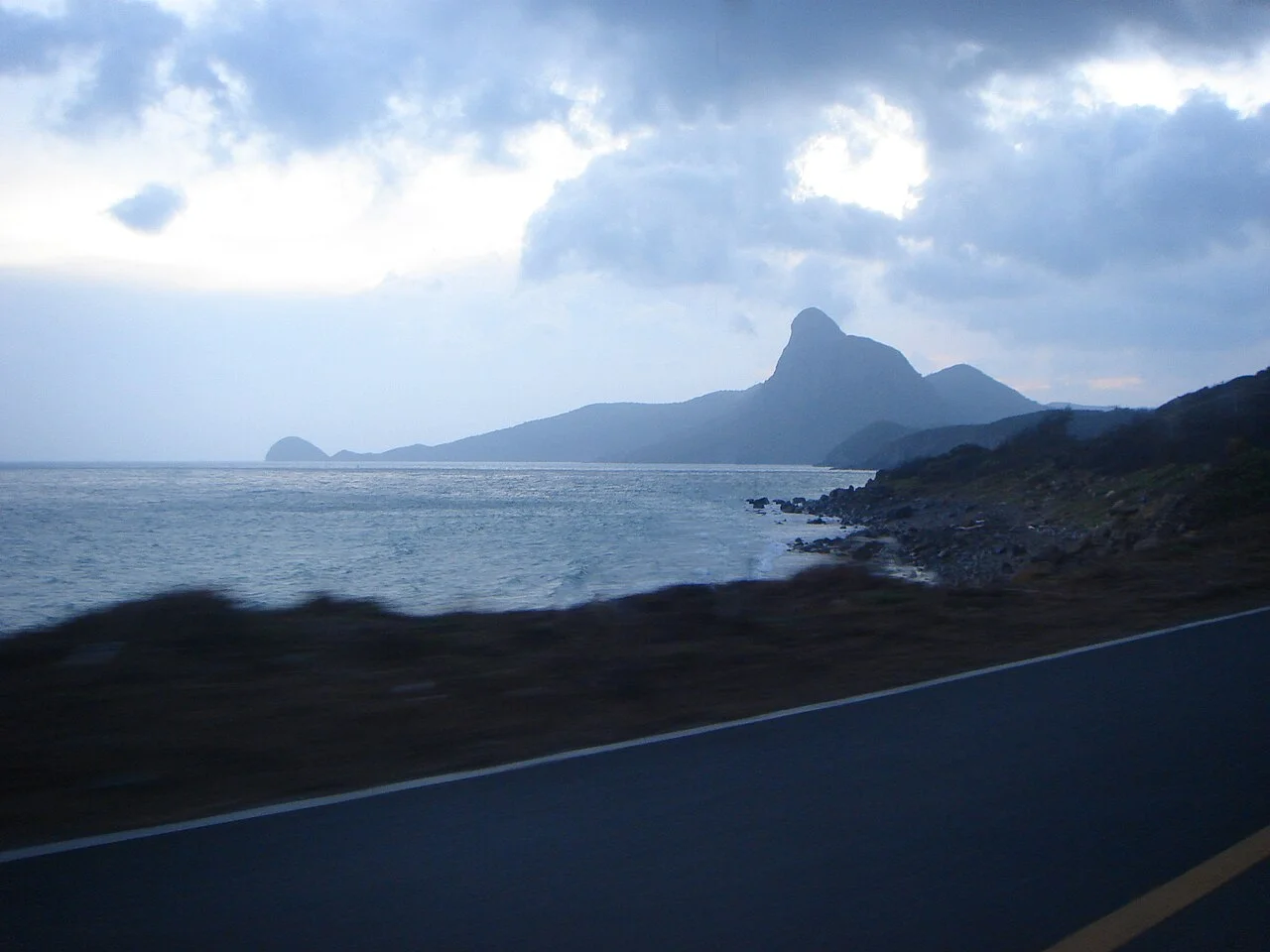
地区或交通示意照片,不代表承诺的停留点。 ©
Use two days to balance the island's difficult history with its coastal landscape. Keep memorial visits unhurried and let the second day focus on beaches and the harbour road.
Sixteen islands and one road
Côn Đảo is sixteen islands, fourteen of them clustered together and two — Trứng Lớn and Trứng Nhỏ — sitting apart to the west and only attached to the district in 1995. Seventy-six square kilometres of land altogether, of which Côn Sơn is 51.52. It lies 97 nautical miles from Vũng Tàu by sea and 40 from the nearest point of the mainland, on the same longitude as Ho Chi Minh City and the same latitude as Cà Mau. Since 16 June 2025 it has been an administrative unit of a kind Vietnam has very few of: Resolution 1685/NQ-UBTVQH15 turned the district into the Côn Đảo special zone of Ho Chi Minh City — 75.79 square kilometres and 6,143 people, in nine residential areas. What that means for a rider is simple. There is one town, one road north to the airport and the beaches, one road south to the harbour, and a handful of turnings. You will ride the same tarmac more than once, and it will not matter.
Pulau Kundur
The old name, Côn Lôn, comes from the Malay Pulau Kundur — gourd island — which Europeans wrote as Poulo Condor and Khmer speakers as Koh Tralach. A ninth-century Arab merchant, Soleyman, recorded a group of islands in the southern China sea as Cundur-fũlát; the French scholar Gabriel Ferrand identified it with Poulo Condore, forty miles south of the Mekong mouths. Marco Polo wrote that in 1294, coming home from China, a storm sank eight of his fourteen ships and the rest sheltered here. In 1702 the English East India Company landed 200 men and eight ships under Allen Catchpole, planted a flag and built a fort with guns on all four sides; the Nguyễn governor Trương Phúc Phan answered by recruiting fifteen Malay men who went out to work for the English, waited a year, and in November 1703 set fire to the camp at night. The company's people escaped by sea. Eighty years later, on 28 November 1783, Pigneau de Béhaine signed the Treaty of Versailles on Nguyễn Ánh's behalf — the first document to promise France these islands. The French Revolution meant it was never carried out.
A hundred and thirteen years
On 14 January 1862 the cargo ship Nievre landed men to put up a temporary lighthouse. On 1 February General Bonard signed the order founding the prison. On 5 June the Huế court signed the Treaty of Nhâm Tuất, the third article of which ceded Côn Lôn outright; on 16 May 1882 President Jules Grévy made it a district of Cochinchina. What followed was the largest place of imprisonment and exile in Indochina. In September 1954 Ngô Đình Diệm kept the system and renamed the islands Côn Sơn, and the American war brought its own prisoners. It ended at midnight on 30 April 1975, when the political prisoners in block GH of camp 7 rose and took the prison — a hundred and thirteen years after it opened. About twenty thousand Vietnamese died here across those generations and are buried at Hàng Dương. The cemetery was rebuilt from 19 December 1992 over some twenty hectares in four sections: 688 graves in A, of which 597 are nameless; 695 in B, 419 nameless; 373 in C; and 157 in D, brought in from the Hòn Cau and Hàng Keo burial grounds, of which only fourteen have names.
The cages
The French built the first tiger cages in 1940 as camp Phú Tường: 5,475 square metres, 120 solitary cells in two blocks of sixty, barred from above with a walkway between so that warders could look down and throw lime powder or dirty water on the men below, and sixty roofless cells beside them called sun-bathing rooms, used to leave prisoners in the sun and the rain. The Republic of Vietnam built the second set in 1971 as camp 7, Phú Bình: 25,768 square metres, 384 concrete solitary cells in four blocks, no sleeping platform, so that men lay on damp cement. That the cages existed at all was denied until July 1970, when the American journalist Don Luce and the congressional aide Tom Harkin, using a map drawn by a former prisoner, stepped off the official route into an alley between two blocks and found the door. Harkin's photographs ran in Life on 17 July 1970. In the outcry that followed, 180 men and 300 women were moved out; a number went to psychiatric hospitals. There is also the Chuồng Bò, which began in 1876 as a cattle yard for the garrison's meat; nine cells were added in 1930 for women prisoners, and in 1963 the twenty-four pig stalls were rebuilt as thirty-three solitary cells.
The turtles, and a shrine that may be a mistake
The national park was declared on 31 March 1993 and covers 19,883 hectares, of which 14,000 are sea: 1,800 hectares of coral reef, 1,000 of seagrass, 32 of mangrove. It holds 1,077 higher plants, 44 of them first described here and eleven carrying Côn Sơn in their names, six endemic animals including the Côn Đảo long-tailed macaque, and 1,725 recorded marine species. It is a Ramsar site and an ASEAN heritage park; more sea turtles are hatched and released here than anywhere else in Vietnam, and it is the only place in the country where dugongs still live on the seagrass. Off to the east, on Bảy Cạnh, stands the lighthouse that convict labour moved from the hill above Cỏ Ống on 27 August 1883, with a focal plane 212 metres up. And on the road west of town there is a shrine to Bà Phi Yến, said to be a concubine of Nguyễn Ánh exiled to the small island for arguing against asking the French for help. It is worth knowing that recent research finds no record of Nguyễn Ánh ever fleeing here and no such concubine in the dynastic genealogy; the folklorist Nguyễn Thanh Lợi traces the cult instead to the central-Vietnamese worship of Thiên Y Ana combined with the southern water-spirit tradition.
这段旅程由我们亲自带队。
向导来自我们的团队,路线我们亲自骑过,整个行程您只需与我们一个对话。
- 来自我们团队的向导
- 我们亲自骑过的路线
- 我们在 5 座城市设有维修点,另有合作维修站
- 整个行程只需与我们一个对话
- 16
- 座城市
- 24
- 条旅行线路
- 71
- 条路线
- 6
- 家维修点