Can Tho : matinées sur le fleuve et vergers
Ninh Kieu · Cai Rang · Phong Dien · Binh Thuy
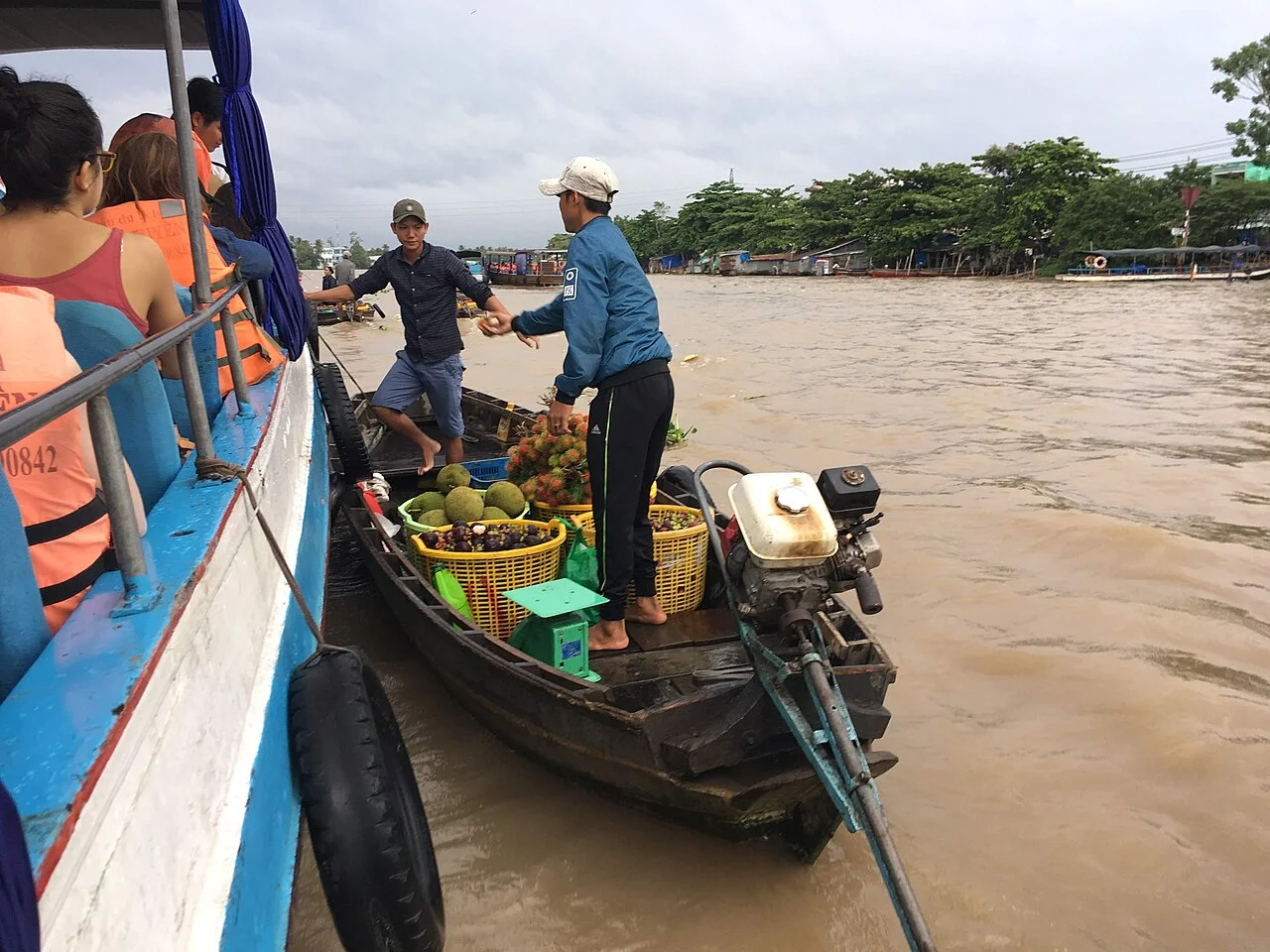
Photo de région ou transport, pas un arrêt garanti. ©
Begin with the river while it is active, then take a separate ride towards orchard country. A market boat visit and a motorcycle outing are different parts of the day, with time to switch between them.
Tây Đô, the capital of the west
Cần Thơ appeared on the Vietnamese map in 1739, when Mạc Thiên Tứ added four new districts on the right bank of the Hậu river to the land of Hà Tiên and called this one Trấn Giang. It has been the unofficial capital of the delta ever since — Tây Đô, the great city of the west — and today it is one of the nine cities governed directly from the centre. The 2025 reorganisation made it very much larger: Cần Thơ was merged with the provinces of Hậu Giang and Sóc Trăng into a single city of 103 commune-level units, about 6,360 square kilometres and more than four million people, with its administrative centre in the ward of Ninh Kiều. The ground under all of it is Mekong silt, one to two metres above the sea, still being laid down by the river; the Hậu carries sand islands past the city — cồn Ấu, cồn Khương, cồn Sơn — and the water table is so near the surface that the roads out to the orchards run on raised banks between canals.
The market that opens at three in the morning
Cái Răng is a wholesale market that happens to float. Boats gather from two or three in the morning, the thick of it is between four and six, and trade goes on in a thinner way for the rest of the day; for a visitor the hour worth being there is five to six. Nobody hangs a signboard, because a signboard cannot be read from a moving boat: instead each seller ties a sample of what is aboard to a tall pole, the bẹo, so that a buyer reads the cargo of twenty boats from a distance. A pot plant on the pole means the boat itself is for sale rather than the fruit. The vessels are ghe bầu, and most of them are homes: a family of two or three generations lives aboard, with pot plants, a dog, a television and sometimes a motorcycle parked on the deck. In 2016 the Ministry of Culture, Sports and Tourism listed the market as national intangible cultural heritage — not the produce, the practice.
Bình Thủy, the village that kept its houses
Five kilometres north-west of the centre is the one place in the city where the nineteenth century is still standing. The communal house was raised in 1844 for the guardian spirit of Bình Hưng village. In 1852 the imperial inspector Huỳnh Mẫn Đạt was caught by a squall on the river, sheltered at the mouth of the creek and survived; he petitioned the emperor Tự Đức, who granted the village spirit the title Bổn Cảnh Thành Hoàng on 29 November that year. The present building went up between 12 July 1909 and 1910. Around 1908 the village was renamed Long Tuyền — the dragon's spring, because the creek lies like a sleeping dragon — which is why the temple is also called the Old Shrine of Long Tuyền; its Kỳ Yên festival was listed as national intangible heritage in January 2018. A few hundred metres away stands the Dương family house, built in 1870, rebuilt by Dương Chấn Kỷ from 1904 and finished in 1911: five bays under one roof, French tile and Vietnamese carpentry, the model example of the Indochinese style in the southern delta. Film crews know it; it is the house in The Lover.
The Cantonese hall and the bridge
On the waterfront itself, twenty metres from the wharf, is the Quảng Triệu assembly hall, built by Cantonese families from the prefectures of Guangzhou and Zhaoqing who had been settling in Trấn Giang since the seventeenth century. It was begun in 1894 on 532 square metres and finished in 1896, laid out on the plan of the character 國 around an open skywell, and nearly everything in it — the wooden columns, the stone bases, the couplets, the beams, the bronze bell and the censers — was shipped from Guangdong and carries the date 1896. People call it Chùa Ông because Quan Công sits in the main hall. It has been a national monument since 21 June 1993 and it has barely changed since the day it opened. Downstream of it stands the other landmark, and a harder one: the Cần Thơ bridge, begun on 25 September 2004, whose 87-metre approach span on the Vĩnh Long side collapsed on the morning of 26 September 2007 and killed dozens of the workers under it — the reported death toll differs from source to source. The bridge opened on 24 April 2010, with a main span of 550 metres, the longest cable-stayed span in South-East Asia at the time.
A day made of two halves
This day is water first and road second, and the two do not mix: the boat to Cái Răng is its own arrangement from the Ninh Kiều wharf, it leaves before dawn, and the motorcycle stays ashore in a guarded park while you are on the river. Come back for breakfast, then ride: south-west along the Cần Thơ river to Phong Điền through the orchards, a loop of the lanes there, back north through Bình Thủy for the temple and the old house, and into the centre along the levee. About fifty kilometres in all, none of it fast. The lanes between the canals are the thing to respect — often two metres wide, with concrete edges and no railing, a metre above black water, and a footbridge every few hundred metres. Ride them slowly, keep to the crown, and when a scooter comes the other way, one of you stops.
C’est nous qui menons ce voyage.
Le guide fait partie de notre équipe, nous avons parcouru l’itinéraire nous-mêmes, et vous avez une seule conversation avec nous pour tout le voyage.
- Des guides de notre équipe
- Des itinéraires que nous avons parcourus nous-mêmes
- Notre atelier dans 5 villes et des ateliers partenaires
- Une seule conversation avec nous pour tout le voyage
- 16
- villes
- 24
- circuits
- 71
- itinéraires
- 6
- ateliers