벤째: 코코넛 고장에서의 주말
Ben Tre · river villages · orchard roads · Ben Tre
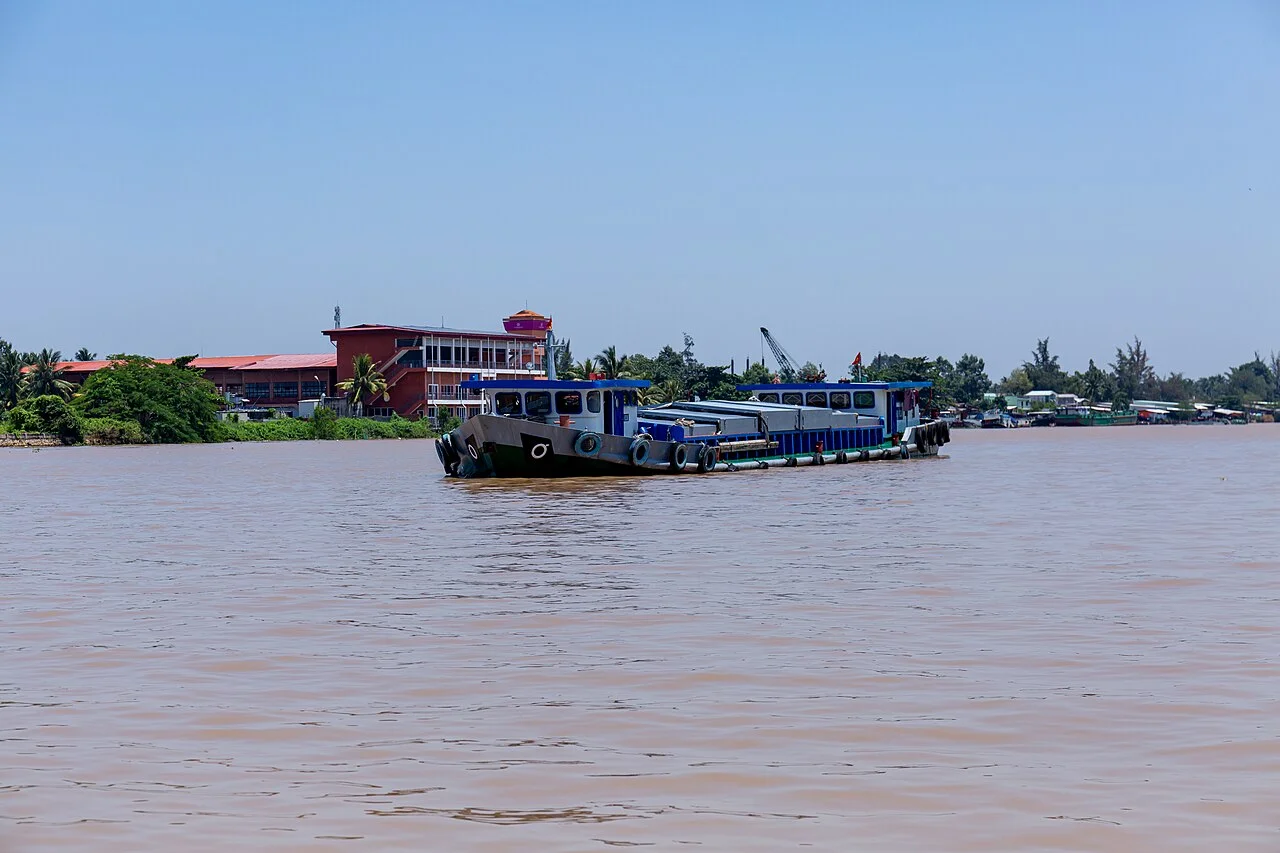
지역 또는 교통 참고 사진이며 약속된 방문지는 아닙니다. ©
Stay in the delta and explore from a single base over two days. Short rides leave room for conversations, a shaded lunch and a separately arranged boat trip.
A province that stopped being one
Bến Tre was a province for a hundred and twenty-five years, from 1 January 1900 until 1 July 2025, when Resolution 202/2025/QH15 folded it and Trà Vinh into Vĩnh Long. The city that was its capital is now five wards — An Hội, Bến Tre, Sơn Đông, Phú Tân and Phú Khương — and the province survives as the north-eastern corner of a larger one. The land itself is unchanged, because it was never made by decree. It is three islets, cù lao An Hóa, cù lao Bảo and cù lao Minh, laid down by four arms of the Mekong: the Tiền for 83 kilometres, the Cổ Chiên for 82, the Hàm Luông for 71 and the Ba Lai for 59. Altogether 2,360 square kilometres, 65 kilometres of coast, and about 6,000 kilometres of rivers, creeks and canals. The Khmer called this country Sóc Treay, the place of fish. The Vietnamese who came later set up a market they called Bến Tre, the creek that ran past it took the name, and in time so did everything else.
Why the riding here is short
Six thousand kilometres of water is excellent for boats and a permanent problem for roads. Everything has to be bridged or ferried, and the province spent most of its history being ferried: the Rạch Miễu, Hàm Luông and Cổ Chiên bridges on Highway 60 are recent, and the crossings at Tân Phú, Hưng Phong, Tam Hiệp and Mỹ An – An Đức still run. The ground is flat to a degree that is hard to believe until you ride it — one to two metres above the sea, with a total relief across the whole province of three and a half metres. The highest ground, over five metres in places, is around Chợ Lách and part of Châu Thành, which is exactly where the fruit is. Salt is the other constant: 43 per cent of the soil is saline against 27 per cent alluvial, and in the dry months, when the flow from upstream drops and the gió chướng blows, seawater pushes far up the creeks. Tree cover is 1.83 per cent, mostly bần, mắm and đước holding the seaward edge together.
The Coconut Monk
Nguyễn Thành Nam was born in 1909 at Phước Thạnh, in what is now Phú Tân ward, to a well-off family; his father was the head of the canton from 1940 to 1944. In 1928 he went to study in Rouen, and came home in 1935 a qualified chemical engineer. In 1945 he took vows at the An Sơn pagoda in the Bảy Núi hills and then sat three years on a stone plinth before the temple flagpole, in silence day and night through every kind of weather until, as the account puts it, he was skin over bone. In 1950 he built a fourteen-metre platform at Phước Thạnh and meditated on it under a single cloak, living on fruit and mostly on coconut — which is how he got his name — and bathing once a year at Vesak. A letter of protest to President Ngô Đình Diệm in 1958 got him arrested and then released. In 1963 he moved to the islet of Cồn Phụng at Tân Thạch, built the Nam Quốc Phật pagoda and founded his religion there: no sutras and no wooden fish, only meditation, vegetarian food and coconut.
What is left on Cồn Phụng
He kept a rat and a cat in one cage, and showed it to visitors as proof that enemies can live together and that the war could stop. In 1967 he asked the newspapers to publicise his religion and stood for the presidency of the Republic of Vietnam; a follower gave him a pair of elephant tusks, each 1.8 metres long and 45 kilograms, now recognised as the largest in the country and kept at the provincial committee building. One of his followers was the son of the American writer John Steinbeck. After 1975 the religion was banned and the property requisitioned, and he died on 13 May 1990 at the age of eighty-one, in custody, after a fall during an arrest. The islet outlived him. It was Cồn Tân Vinh, a sandbank of about 28 hectares in the 1930s, and silt has since built it past fifty; it is the phoenix among the four islets of this reach named for the sacred animals, and it got that name from an old bowl with a phoenix on it that the pagoda builders dug up. Around 1,500 square metres of his work survive: the nine-dragon court, the Peace tower, the great cast urn. The barge he used as a temple became a floating hotel on the Bến Tre river.
The other things that came out of the coconut
Coconut candy did not start in Bến Tre town. It came from Mỏ Cày, and the first maker the records name is Nguyễn Thị Ngọc, born in 1914, of quarter 1 in Mỏ Cày; the sweet was called kẹo Mỏ Cày then. In 1970 Nguyễn Thị Vinh, born 1945, changed the method and set up the Thanh Long works in Bến Tre town — the first there — and from that point the name was kẹo dừa Bến Tre. The recipe is still coconut meat, sugar and malt syrup. Two other trades of the same kind run along the road east of town: the rice paper of Mỹ Lồng, a village of more than 150 kilns seven kilometres out, and the puffed sticky-rice cake of Sơn Đốc. Both were listed as national intangible cultural heritage in 2018. And the province's name carries something else as well. On the night of 2 January 1960 the provincial committee met at Tân Trung and set a week of general uprising; it opened on 17 January in the three communes of Định Thủy, Phước Hiệp and Bình Khánh in Mỏ Cày, spread through Giồng Trôm, Thạnh Phú and Ba Tri, and from here across the whole south. That was the Đồng Khởi, and it is why the word and the province are hard to say separately.
이 여정은 저희가 직접 이끕니다.
가이드는 저희 팀원이고, 경로는 저희가 직접 달려본 길이며, 여행 내내 저희와 하나의 채팅으로 연결됩니다.
- 저희 팀의 가이드
- 저희가 직접 달려본 경로
- 5개 도시의 저희 정비소와 파트너 정비소
- 여행 내내 저희와 하나의 채팅
- 16
- 개 도시
- 24
- 개 투어
- 71
- 개 노선
- 6
- 개 정비소