Bac Ha : marché et collines fruitières
Lao Cai · Bac Ha · nearby villages · Bac Ha
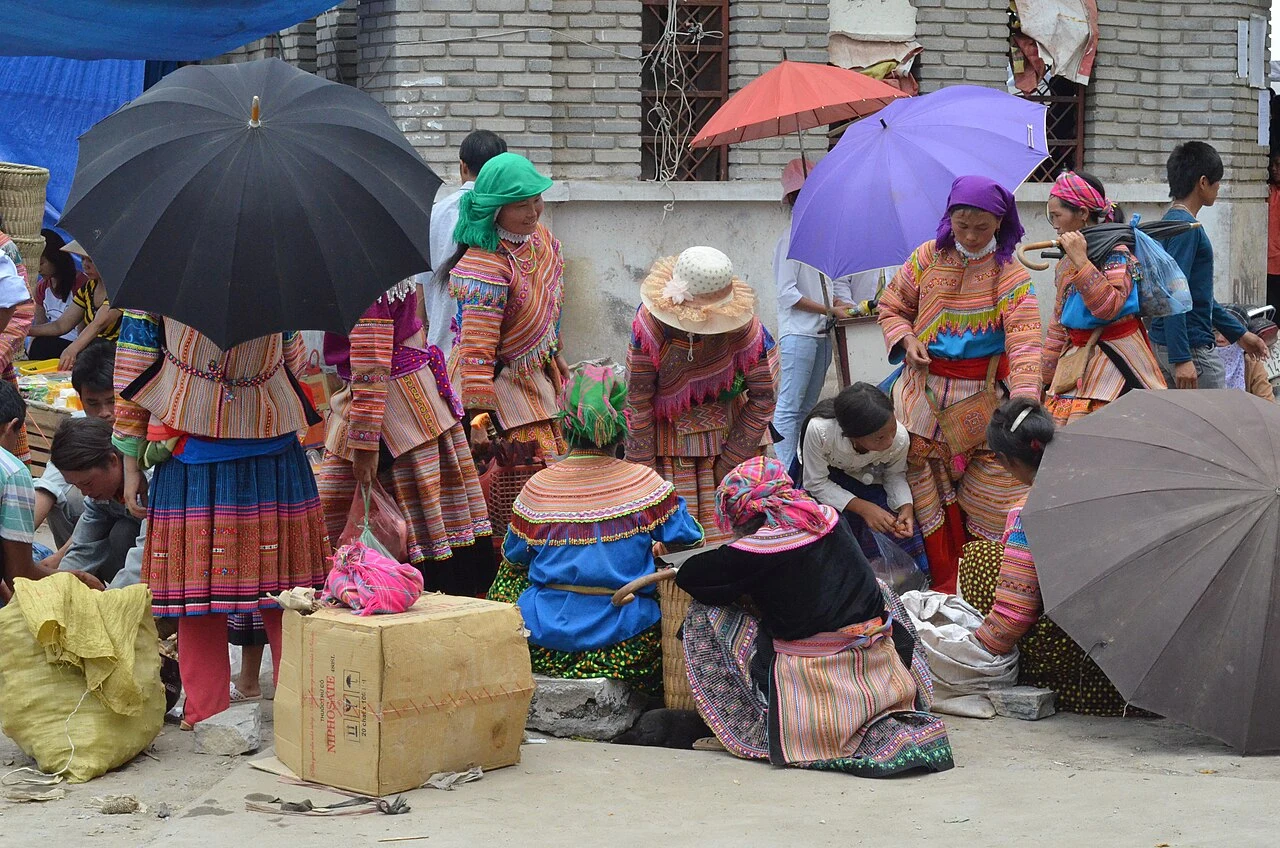
Photo de région ou transport, pas un arrêt garanti. ©
Spend two days around a single highland base. The approach brings changing landscapes; the second day stays local so a market or village walk can set the schedule.
Pạc ha: a hundred bundles of thatch
The name is Tày and it is domestic. Pạc ha means a hundred bundles of thatch; the French wrote the sound down in Latin letters as Pakha, Vietnamese speakers wore it into Bắc Hà, and that became the official name of the place. The other name it carries, the white plateau, is younger than it sounds. Until the middle of the 1980s these hills grew opium poppy, and not quietly: in the 1985–86 season the country had 19,055 hectares of poppy and cannabis planted and took 53,883 kilogrammes of opium off the harvest, with Lào Cai among the provinces involved. From 1993 the state worked at persuading people out of the crop, and Lào Cai's answer in Bắc Hà was a project to plant plums instead. Every spring the hills now go white with plum blossom, and that is where the white plateau comes from. The old district covered 681 square kilometres and held 67,472 people of eighteen ethnicities, more than 47 per cent of them Mông. It sits between 1,000 and 1,500 metres on limestone, slopes averaging 24 to 28 degrees, and the air is cool enough for temperate fruit.
The house the district chief built
On a low hill above the Bắc Nà stream stands a two-storey building that does not look like anything else for a hundred kilometres. Hoàng Yến Chao, a Tày who held the post of châu úy — head of the Bắc Hà sub-prefecture under the French — began it in 1914 and finished it in 1921, on a site of more than ten thousand square metres with about four hundred square metres of floor. A French architect and a Chinese one designed it together, Western form set out according to Eastern geomancy, and the result is usually described as an unusually fluent piece of East–West crossbreeding rather than a colonial copy. The family lived in it until 1950. Because the man who ruled from it governed a district roughly seventy per cent Mông, local speech called him the Mèo king and the building his palace; the name that stuck to the house is his son's, Hoàng A Tưởng. It became a national monument on 11 June 1999. Restoration has not put everything back — the owner's second-floor escape stair is sealed — and what has survived is small and personal: a set of old hardwood furniture, a Chinese wall mirror, and three sweet olive trees in the yard as old as the house.
One day a week
The market has met on Sunday and only on Sunday since Lào Cai province was created in 1907, and the town is built around that fact. It is sixty-five kilometres from the city of Lào Cai, and it is not one market but a set of them sharing a hillside: brocade, food, horses, poultry, produce, songbirds and smiths, each with its own ground. People coming down off the mountains put on new clothes for it — the custom is still kept — and the province's own description calls it one of the most distinctive periodic markets in South-East Asia, a place for trading what the forest and the terraces produced and for the Mông, Dao, Tày and Nùng to look at each other once a week. It is also, plainly, where young people arrange to meet after six days of work. If your week does not land on a Sunday, Cốc Ly holds its market every Tuesday, thirty kilometres west beside the suspension bridge over the Sông Chảy; it is smaller, it serves the Flower Mông, Black Dao and Nùng of the western valleys, and it is the better morning of the two if you dislike crowds.
Born beside the manger
The horse market is not a display. The Bắc Hà horse, also called the Mông horse, is a working breed: 1.2 to 1.5 metres at the withers, a body 1.2 to 1.3 metres long, 130 to 170 kilogrammes, thin legs that are hard as wire on rock. Lào Cai keeps more than five thousand of them, concentrated in Bắc Hà, Si Ma Cai and Mường Khương, because on these gradients a horse still beats a motorbike for carrying maize up to a field. A local saying has it that the men of Bắc Hà are born beside the manger and grow up on horseback; at Tết people paste red paper on the stable and give the horse a piece of the bánh chưng, which is how you thank an animal for a year. The town races them every year on its central ground. The same animal is the reason for thắng cố, the Mông dish this market is known for, boiled all morning in a cast-iron pan over charcoal and ladled out while the pan is still on the fire. A man from Bản Phố who cooks it well dates it to about two hundred years ago, when the Mông, Tày and Nùng settled in Bắc Hà.
How the two days work
Ride up on Saturday, wake up in the town on Sunday. That is the whole plan, and it is worth arranging your week around, because the market is the reason to be here and it exists for one morning. The approach is seventy kilometres: National Highway 70 south-east out of Lào Cai to the Cốc Xâm junction in Phong Niên, then provincial road 153 north-east, twenty-five kilometres of steady climbing onto the plateau. Sunday morning belongs to the market and the palace above it; the afternoon is for the short loops — west to Bản Phố, where the Mông and Dao distil maize spirit with water from the Hang Dế stream, and north-west into the orchards around Tả Van Chư. One administrative note: on 16 June 2025 the town of Bắc Hà was merged with Na Hối, Thải Giàng Phố, Bản Phố, Hoàng Thu Phố and Nậm Mòn into a single commune called Bắc Hà, and Lào Cai province absorbed Yên Bái on 1 July 2025. The signs and the way people talk have not caught up, and neither has this guide, which uses the names you will hear.
C’est nous qui menons ce voyage.
Le guide fait partie de notre équipe, nous avons parcouru l’itinéraire nous-mêmes, et vous avez une seule conversation avec nous pour tout le voyage.
- Des guides de notre équipe
- Des itinéraires que nous avons parcourus nous-mêmes
- Notre atelier dans 5 villes et des ateliers partenaires
- Une seule conversation avec nous pour tout le voyage
- 16
- villes
- 24
- circuits
- 71
- itinéraires
- 6
- ateliers