Ba Be : un week-end entre lac et forêt
Ba Be · Pac Ngoi · lake access · Cho Ra · Ba Be
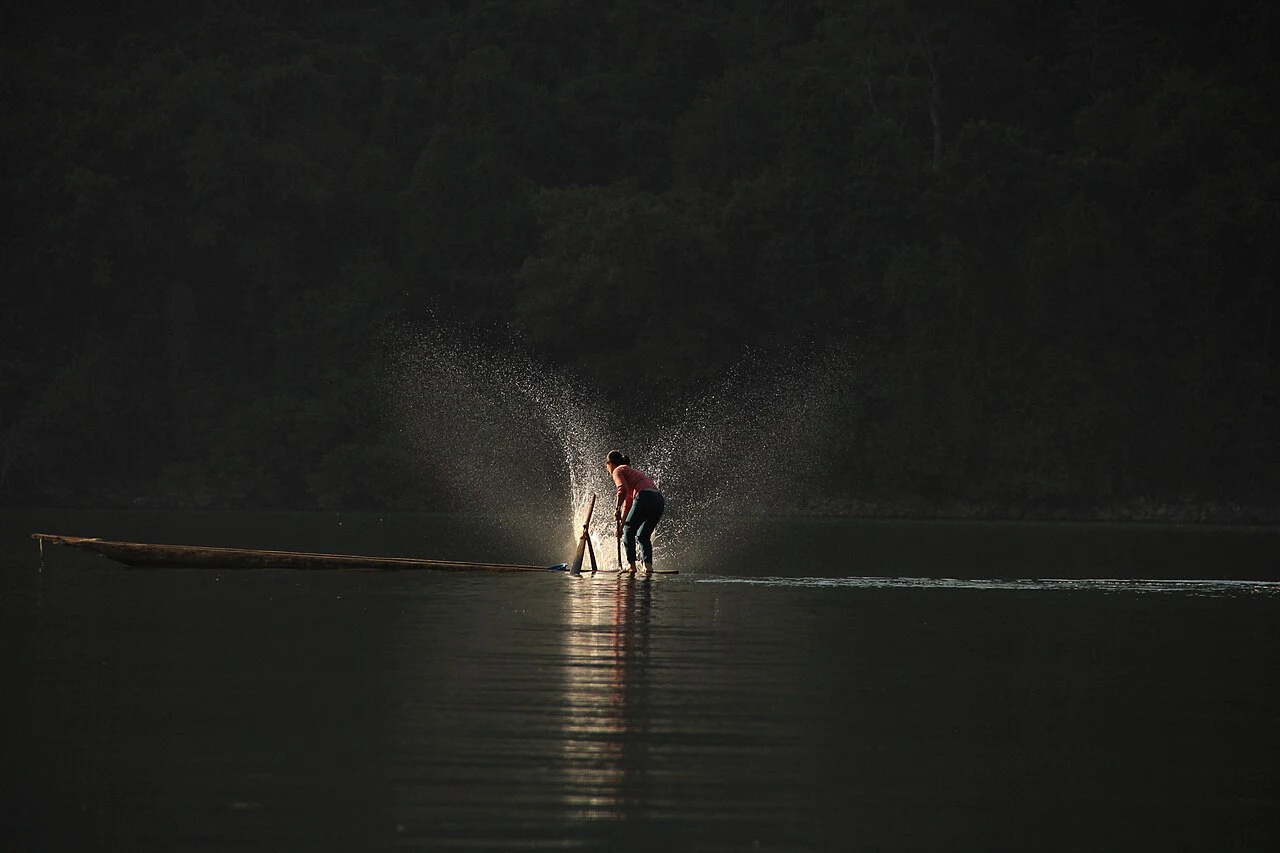
Photo de région ou transport, pas un arrêt garanti. ©
Base yourself beside the lake for two nights and use the bike for the surrounding roads. A separate boat outing creates a welcome day with almost no riding.
Slam Pé: the three lakes
The Tày name is the accurate one. Slam Pé means three lakes, because the water is divided by limestone ridges into three basins joined by narrow necks, and each has its own name: Pé Lầm, Pé Lù and Pé Lèng. Together they make the largest natural freshwater lake in Vietnam and one of the hundred largest in the world, sitting at 145 metres above the sea with more than 650 hectares of surface, held up in a bowl of limestone mountains between 1,400 and 1,600 metres high on the Sông Gâm arc. Depths run 20 to 25 metres in the rains and drop to about ten in the dry season. Two small rivers, the Chợ Lèng and the Nam Cường, feed it and the Sông Năng drains it; the water moves at about half a metre a second, and at two and a half to three when the flood is on. Two islands stand in it, An Mã and Bà Góa, and both belong to the same story.
The beggar who was a dragon
The Tày tell it like this. The village of Nam Mẫu held a great Buddhist offering each year, and one year a leprous old woman came to it begging. She stank, her clothes were rags, and every house drove her off — except one, a widow living with her son, who fed her and let her sleep in the corner by the rice bin. In the night the two of them woke to a noise like thunder from the store, opened it, and found not the old woman but a great water dragon, its head on the bed and its tail on the floor. In the morning the beggar told them what she was: she had come to test the charity of the people who came to worship, they had all failed, and a flood was coming. She gave them a packet of ash to scatter round the house and two rice husks. When the water came the next day, the ground under their house rose as fast as the flood, the two husks became two boats, and the mother and son spent the flood pulling their neighbours out of it. What was left was three lakes. The small island is Bà Góa, the widow's island; the other is An Mã, where the drowned were laid.
What the park is holding
Ba Bể National Park was declared by decision on 10 November 1992 and covers 7,610 hectares, of which 3,226 are strictly protected. It is a rare combination — evergreen forest on limestone, a lake up in the mountains, and lowland evergreen forest — and the counts are extraordinary for the size. Surveys list 1,281 plant species in 162 families, including ironwood, đinh, lim and the trúc dây, a bamboo endemic to Ba Bể that grows out of the cliffs and hangs down over the water like a curtain. Botanists rate this the richest and most endemic place for orchids not only in Vietnam but in South-East Asia, with 182 species recorded, some found nowhere else. The animal list runs to 81 mammals, 322 birds, 106 fish, 27 reptiles, 17 amphibians and 553 insects and spiders. A hundred and six fish species in one lake is the national record: Lắk has 35, Hồ Tây 36. The globally threatened François' langur and Owston's civet are both here, though the langurs are now very few. In 1995 a world freshwater lake conference in the United States named Ba Bể one of twenty lakes needing protection; the park became an ASEAN Heritage Park at the end of 2004, and the lake was made a special national monument on 27 September 2012.
The river that goes under the mountain
The Sông Năng does something worth riding out to see. Five kilometres from Chợ Rã it runs straight into the Lũng Nham limestone and goes under it, and the hole it has cut is Động Puông: three hundred metres long, over thirty metres high, sheer walls and stalactites, and tens of thousands of bats living in the roof. Boats go through it. Eight kilometres downstream of the cave the river forks — left into the lake, straight on for another three kilometres to the landing for Đầu Đẳng. There, sixteen kilometres from Chợ Rã and right on the Tuyên Quang boundary, the Năng meets a field of enormous boulders and breaks into a fall more than a thousand metres long in three steps, each three or four metres below the last, between two limestone walls with primary forest on them. Cá chiên of over ten kilogrammes are still caught in the pools below it, which tells you something about how little of this river has been fished out.
How the weekend works
Two nights at the lake and about a hundred kilometres of riding, most of it easy. Base yourself at Pác Ngòi, a Tày village of stilt houses on the water where the guest houses are, and use the bike for the land and a boat for everything else — Puông cave and the Đầu Đẳng falls are both properly seen from the river, and the boat day is the one with almost no riding in it. Day one: in from Chợ Rã along the Năng, look at the cave from the road, and settle in before dark. Day two: the boat. Day three: the road loop south to the Hua Mạ cave and back round the lake. Two things to know. The park charges to enter and the boats are arranged in the village, so agree the price and the route before you get in. And this place is under pressure: iron ore mining in the catchment has silted the lake badly enough that Pé Lèng has lost about a third of its area, and scientists have said in plain terms that the lake is dying. Ride like a guest.
C’est nous qui menons ce voyage.
Le guide fait partie de notre équipe, nous avons parcouru l’itinéraire nous-mêmes, et vous avez une seule conversation avec nous pour tout le voyage.
- Des guides de notre équipe
- Des itinéraires que nous avons parcourus nous-mêmes
- Notre atelier dans 5 villes et des ateliers partenaires
- Une seule conversation avec nous pour tout le voyage
- 16
- villes
- 24
- circuits
- 71
- itinéraires
- 6
- ateliers